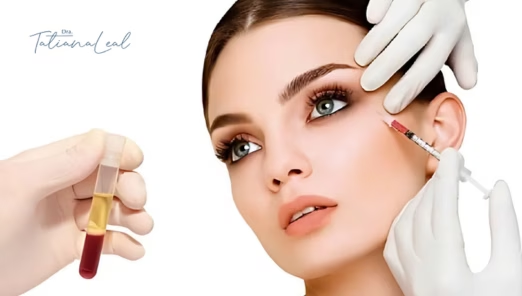
Platelet-Rich Plasma (PRP) is an aesthetic treatment based on using components from your own blood. This procedure aims to improve skin health and appearance, as well as treat various scalp conditions. PRP benefits range from facial rejuvenation to improved skin texture.
What is Platelet-Rich Plasma?
Platelet-Rich Plasma, also known as PRP, is a treatment that uses autologous components from your blood to stimulate cellular regeneration and improve skin health. This approach stands out in aesthetic medicine for its natural results. Because the plasma comes from your own bloodstream, there is no risk of allergic reaction or disease transmission — the treatment works entirely within your body’s own biological systems.
| Component | Primary Function | Clinical Benefits |
|---|---|---|
| Platelets | Coagulation and repair | Tissue regeneration |
| Growth factors | Cellular proliferation | Collagen stimulation |
| Cytokines | Cell communication | Diverse biological functions |
| Plasma | Nutrient transport | Hydration and nourishment |
Extraction and Preparation Process
The Platelet-Rich Plasma collection involves a specific procedure consisting of several steps:
- Blood Collection
- Sample taken from patient
- Similar to routine blood work
- Using sterile syringe
- Centrifugation
- Blood undergoes high-speed processing
- Component separation
- Platelet isolation
- Concentration
- Obtaining platelet-rich fraction
- Treatment preparation
- Autologous purity guaranteed
The entire process, from blood draw to reinjection, typically takes place within the same appointment, since the plasma must be used shortly after processing to preserve the activity of its growth factors.
Preventive collagen biostimulation: why Dr. Tatiana Leal recommends it from age 25
Collagen starts decreasing at 1% per year from age 25. Biostimulators can intervene before that loss becomes visible. Dr. Tatiana Leal explains when it makes sense and what options exist.
Read moreBenefits of Platelet-Rich Plasma for Skin
Platelet-Rich Plasma offers multiple benefits for skin health, contributing to its rejuvenation and overall improvement. Its application allows patients to achieve fresher, healthier-looking skin.

Facial Rejuvenation
This treatment is highly valued for its ability to revitalize the face. Through collagen production stimulation, patients can achieve visible results in a short time.
Reduction of Wrinkles and Expression Lines
One of PRP’s most notable effects is the reduction of wrinkles and expression lines. As skin loses elasticity over time, these marks develop. When PRP is injected, it stimulates cellular regeneration and promotes a younger appearance.
Achieving Smoother, Radiant Skin
After treatment, many patients notice their skin feels smoother with a natural glow. Collagen and elastin production helps make the skin appear firmer and more vibrant.
Benefits of PRP for the Scalp
| Aspect | Before PRP | After PRP |
|---|---|---|
| Hair density | Sparse or reduced | Significant increase |
| Hair thickness | Thin and weak | Greater thickness and strength |
| Circulation | Reduced | Enhanced stimulation |
| Hair follicles | Inactive | Reactivated |
| Overall quality | Deteriorated | Strengthened and healthy |
Scar and Blemish Reduction
This treatment is effective in reducing scars, including those from acne. The growth factors present in PRP help smooth the skin, promoting regeneration and even appearance.
Increased Hydration and Elasticity
Platelet-Rich Plasma increases skin hydration by optimizing collagen production. This leads to more elastic skin, particularly beneficial in areas prone to dryness and sagging.
Growth Factors and Collagen Production
Growth factors play a fundamental role in stimulating collagen production, an essential component for maintaining skin structure and firmness. As we age, natural collagen production slows, which is why treatments that stimulate the body’s own regenerative response — rather than simply adding volume — have become a cornerstone of modern aesthetic medicine.
Mechanisms of Action
Growth factors such as PDGF, TGF-β, and VEGF are released as platelets activate at the treatment site, directly triggering the biological cascade responsible for new collagen formation and tissue repair. In PRP, these growth factors work in different ways:
- Fibroblast Stimulation
- Collagen and elastin production
- Active cellular regeneration
- Inflammatory Response
- Healing facilitation
- Tissue repair
- Angiogenesis
- Blood vessel formation
- Improved oxygenation and nutrition
Prejuvenation: what preventive aesthetic medicine is and why it is changing the anti-aging approach
Prejuvenation is the approach that intervenes before visible aging signs appear. It is not anti-aging — it is pre-aging. Dr. Tatiana Leal explains what it consists of and why more patients aged 25–40 are adopting it in Colombia.
Read moreComparison with Other Aesthetic Treatments
In aesthetic medicine, PRP stands out for several reasons. Compared to procedures like dermal fillers or botulinum toxin, PRP uses autologous components, reducing the risk of adverse reactions.
- More natural, using your body’s own resources
- Results can be longer-lasting, promoting cellular regeneration
- Shorter recovery time compared to surgical treatments
Unlike synthetic biostimulators such as Sculptra or Radiesse, which physically occupy space beneath the skin, PRP works purely through the patient’s own biological signaling — with no volumizing effect and no risk of nodule formation, since no foreign material is involved.
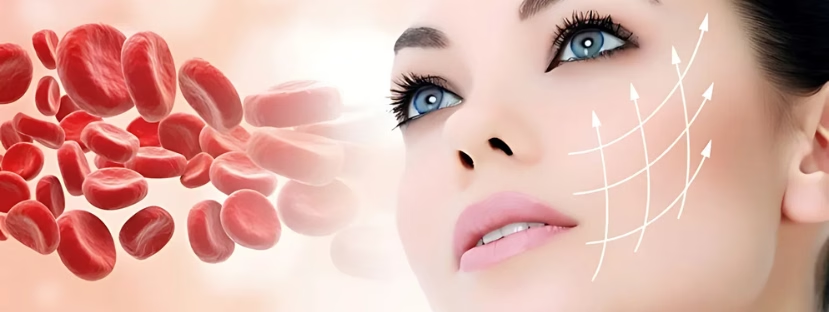
PRP Advantages in Plastic Surgery
PRP has found its place as a complement to plastic surgery procedures, enhancing their effects. This treatment is used not only to improve skin appearance before intervention but also postoperatively to accelerate healing.
- Reduces inflammation and speeds recovery time
- Improves healing and reduces fibrosis formation
- Provides better results in terms of post-surgery skin quality
Side Effects and Precautions
As with any procedure that uses the patient’s own blood, PRP has an excellent safety profile, though it’s important to understand what to expect afterward.
Possible Effects and Reactions
- Temporary bruising
- Mild inflammation
- Local sensitivity
- Minimal risk of infection
Main Contraindications
- Bleeding disorders
- Active infections
- Autoimmune diseases
- Active cancer
Frequently Asked Questions
How Many Sessions are Needed?
An initial cycle of three sessions is recommended, spaced one month apart. Maintenance sessions are scheduled every six to twelve months.
Expected Results and Maintenance
Results from PRP treatment can be noticed from the first session, though they tend to improve over time. Skin becomes more radiant, smooth, and shows fewer wrinkles. Results vary depending on skin type and individual response. Because PRP relies on the body’s own regenerative capacity, patience is key — most patients see continued improvement over the three months following each session, as collagen remodeling progresses gradually rather than all at once. To maintain desired effects, maintenance sessions at regular intervals are recommended.
Want to learn more about this treatment?
Schedule your consultation with our doctors and discover the ideal treatment for you
Schedule your treatment * Limited spots this weekUpdated: December 2024
Disclaimer: Individual results may vary. All procedures are performed by board-certified doctors in our state-of-the-art facilities.
Hyaluronic acid vs Sculptra: how Dr. Tatiana Leal decides which to recommend
Hyaluronic acid fills immediately. Sculptra stimulates your own collagen over months. They are different tools for different goals — and sometimes the best answer is to combine them.
Read more
Frequently asked questions
How is PRP prepared and what makes it clinically effective?
PRP is prepared by drawing a small blood sample from the patient, which is then centrifuged at high speed to separate and concentrate the platelet-rich fraction. Its effectiveness comes from the concentrated growth factors (PDGF, TGF-β, VEGF) released when platelets activate at the treatment site, which directly stimulate fibroblast proliferation, collagen synthesis, and tissue regeneration.
What skin and hair conditions respond best to PRP treatment?
PRP shows the strongest clinical evidence for early-stage androgenetic alopecia (hair thinning), post-inflammatory scarring, and general skin texture improvement in patients with mild-to-moderate laxity. Conditions involving active cellular damage rather than structural deficits tend to respond more predictably, while deeply atrophic scars or severe elastosis typically require combination approaches.
Can PRP be combined with microneedling or other aesthetic treatments?
Yes, PRP is frequently combined with microneedling in a protocol known as vampire facial or PRP-enhanced microneedling, where the micro-channels created by the needles allow direct delivery of growth factors into the dermis. It can also be used alongside laser resurfacing or radiofrequency to accelerate healing and amplify collagen stimulation beyond what either treatment achieves alone.
How is PRP different from other collagen stimulators like Sculptra or Radiesse?
PRP uses the patient's own biological material with no foreign substances, making it autologous and eliminating allergic reaction risk. Unlike Sculptra (poly-L-lactic acid) or Radiesse (calcium hydroxylapatite), which are synthetic volumizers that physically occupy space while stimulating collagen, PRP works purely through biological signaling with no volumizing effect and no risk of nodule formation.
What are the realistic limits of what PRP can achieve?
PRP is a regenerative stimulator, not a structural volumizer or skin resurfacing tool. It will not replace lost facial volume, eliminate deep static wrinkles, or correct significant skin laxity on its own. Patients with advanced photoaging, deep folds, or significant volume loss will see limited benefit from PRP alone and are better served by a combination protocol with complementary treatments.