
This is a comparison I frequently make in consultations, because more and more patients arrive having heard of both options and wanting to know which is “better.” My usual answer: it depends on what you need. They are different tools for goals that sometimes overlap and sometimes are completely different.
In short: hyaluronic acid is an immediate-action filler — you add volume where it is lacking and the result is visible when the session ends. Sculptra is a biostimulator — there is no immediately visible result, but in the following months your body produces new collagen that progressively improves the quality, density, and volume of the tissue in a gradual, natural way.
The mechanism: filler vs. biostimulation
Hyaluronic acid: the “immediate filler”

Hyaluronic acid (HA) is a molecule that attracts and retains water. When injected, it occupies physical space in the tissue and creates volume. It is, essentially, a “mechanical filler”: you place the substance where volume is lacking, and the volume appears.
Mechanism advantages:
- Immediate, visible result
- Completely reversible (with hyaluronidase)
- Very high placement precision
- Predictable and controllable effect
Mechanism limitations:
- Does not improve intrinsic tissue quality (firmness, elasticity, texture)
- Requires periodic maintenance (6–18 months depending on the zone)
- In excess can create a “filled” or unnatural appearance
Sculptra: the “collagen builder”
Sculptra (PLLA — poly-L-lactic acid) is a biostimulatory substance. When injected, PLLA microspheres act as temporary scaffolding that stimulates fibroblasts to produce new collagen. The PLLA microspheres degrade within weeks, but the collagen they stimulated remains.
Mechanism advantages:
- The result is your own collagen — completely natural
- Improves overall tissue quality (does not just add volume, improves structure)
- Duration of up to 2 years
- The effect is gradual and progressive (no visible “work done”)
Mechanism limitations:
- No immediate result — changes appear between week 4 and month 6
- Requires 2–4 spaced sessions for optimal results
- Not immediately reversible (though collagen eventually gets reabsorbed)
- Less precision for specific zones needing punctual filler

Benefits of Platelet-Rich Plasma: Natural and Effective Rejuvenation
Platelet-Rich Plasma is an aesthetic treatment based on using components from the patient's own blood, aimed at improving skin health and appearance.
Read moreComplete comparative table
| Feature | Hyaluronic Acid | Sculptra (PLLA) |
|---|---|---|
| Mechanism | Mechanical filler | Collagen biostimulation |
| Result | Immediate | Gradual (4–12 weeks) |
| Duration | 6–18 months (by zone) | Up to 2 years |
| Reversibility | Yes (hyaluronidase) | Not immediate |
| Skin quality improvement | No | Yes |
| Zone precision | High | Medium-low |
| Sessions needed | 1–2 per zone | 2–4 sessions |
| “Natural” result | Variable (volume dependent) | Very natural and gradual |
| Price per session | Medium-high | Medium-high |
| Annualized cost | Medium-high | Medium (due to longer duration) |

Lip Fillers: Everything You Need to Know Before Taking the Step
Discover everything about lip fillers: from modern techniques to expert advice for achieving natural, long-lasting results.
Read moreMy clinical criteria: when I recommend each one
Cases where I choose hyaluronic acid
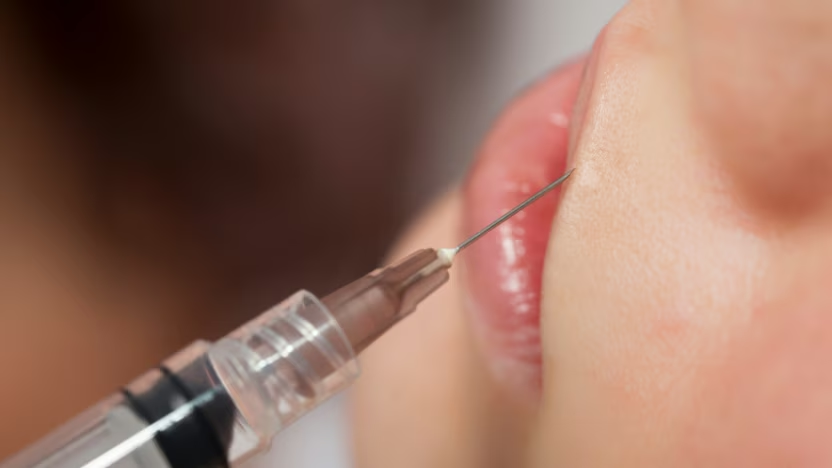
Specific, localized volume goal: When a patient needs more cheek projection, more chin definition, or more lip volume, hyaluronic acid is more precise and predictable.
Asymmetries to correct: For correcting facial asymmetries (one side more projected than the other, a lip with different shape), hyaluronic acid allows the necessary precision.
Immediate result needed: If there is an important upcoming event or the patient needs to see a quick change, hyaluronic acid is the right choice.
Periocular zone (under-eyes): Hyaluronic acid with products specific to this zone is superior to Sculptra here due to the area’s delicacy.
Patient who has never had fillers: Initially, hyaluronic acid allows seeing how the tissue responds, how the patient likes the result, and is reversible if the result is unsatisfying.
Cases where I choose Sculptra
Diffuse volume loss: When aging has produced volume loss in multiple zones in a generalized (not localized) way, Sculptra is superior because it can treat large areas homogeneously.
Goal of improving tissue quality: If skin has loss of firmness and elasticity, Sculptra produces a deep structural improvement that hyaluronic acid does not achieve.
Patient who prefers natural and gradual: Sculptra is ideal for those who do not want visible changes from one day to the next.
Long-term maintenance: For patients who have already achieved the result they want and want to maintain it efficiently, Sculptra offers greater durability.
History of overfilling: Some patients have a history of “too much filler” results they did not like. Sculptra, being gradual, reduces that risk.
The combined protocol: when I use both
In many of my patients, the optimal answer is a combination:
- Sculptra for the foundation: improving tissue quality and density in broad areas (temples, cheeks generally, diffuse jawline)
- Hyaluronic acid for details: precision on lips, under-eyes, specific wrinkles, punctual asymmetries
This combination leverages the best of each tool and is increasingly frequent at our clinic in Bogotá.
What about Radiesse? The middle ground between filler and biostimulator
Many patients ask me where Radiesse fits in this comparison. Radiesse (calcium hydroxylapatite) sits in the middle: like hyaluronic acid, it adds volume from day one; like Sculptra, it stimulates your own collagen over the following months. Its effect lasts 12 to 18 months.
| Hyaluronic acid | Radiesse | Sculptra | |
|---|---|---|---|
| Immediate volume | Yes | Yes | No |
| Stimulates collagen | Not significantly | Yes | Yes |
| Duration | 6–18 months | 12–18 months | Up to 2 years |
| Can be dissolved | Yes | No | No |
| Lips and under-eyes | Yes | No | No |
I choose it when a patient needs support in a specific area, such as a deep fold or the jawline, and wants the result to last longer than a filler, but is not looking for a full-face treatment. If you are deciding between the two biostimulators, see Sculptra vs. Radiesse.
A note on price and real cost
When I compare costs with patients, I always use “annualized cost” as the more honest metric, not the per-session price.
Sculptra costs COP 2,600,000 per vial at our clinic (see the full Sculptra price and protocol) and lasts up to 2 years. Hyaluronic acid varies by brand and treatment area, which we review at your hyaluronic acid evaluation, and lasts 6–18 months. Because Sculptra can last twice as long or more, its annualized cost often comes close to that of hyaluronic acid, even though the upfront outlay is higher. The choice should be based on the goal, not just the per-session price.
For a personalized evaluation and to know which of these options — or which combination — is the most appropriate for you, we invite you to learn about hyaluronic acid treatments at our clinic and schedule your consultation.
Dr. Tatiana Leal is an aesthetic medicine specialist in Bogotá, Colombia.

Facial zones where hyaluronic acid is applied: a zone-by-zone guide
Hyaluronic acid is not a uniform treatment — each facial zone has its own protocol, volume, and product type. Dr. Tatiana Leal explains what to expect zone by zone.
Read more
Frequently asked questions
What is the main difference between hyaluronic acid and Sculptra?
The fundamental difference is in the mechanism: hyaluronic acid is a filler that acts immediately by adding physical volume to the tissue. Sculptra (PLLA - poly-L-lactic acid) is a biostimulator that stimulates your own collagen production over months, producing gradual, natural rejuvenation. HA gives immediate results lasting 6–18 months; Sculptra gives gradual results lasting up to 2 years.
Can hyaluronic acid and Sculptra be combined?
Yes, and it is frequently the optimal combination. Sculptra can be used to improve general skin quality and density and restore volume diffusely, while hyaluronic acid is used for specific corrections and areas needing precision (lips, under-eyes, chin definition). They are complementary, not mutually exclusive.
Is Sculptra more expensive than hyaluronic acid?
Per session, Sculptra may be similarly priced or slightly more expensive than a premium hyaluronic acid syringe. However, since Sculptra lasts up to 2 years vs. 6–18 months for hyaluronic acid, the annualized cost can be similar or even lower. To compare costs, the total protocol cost and expected duration must be considered.