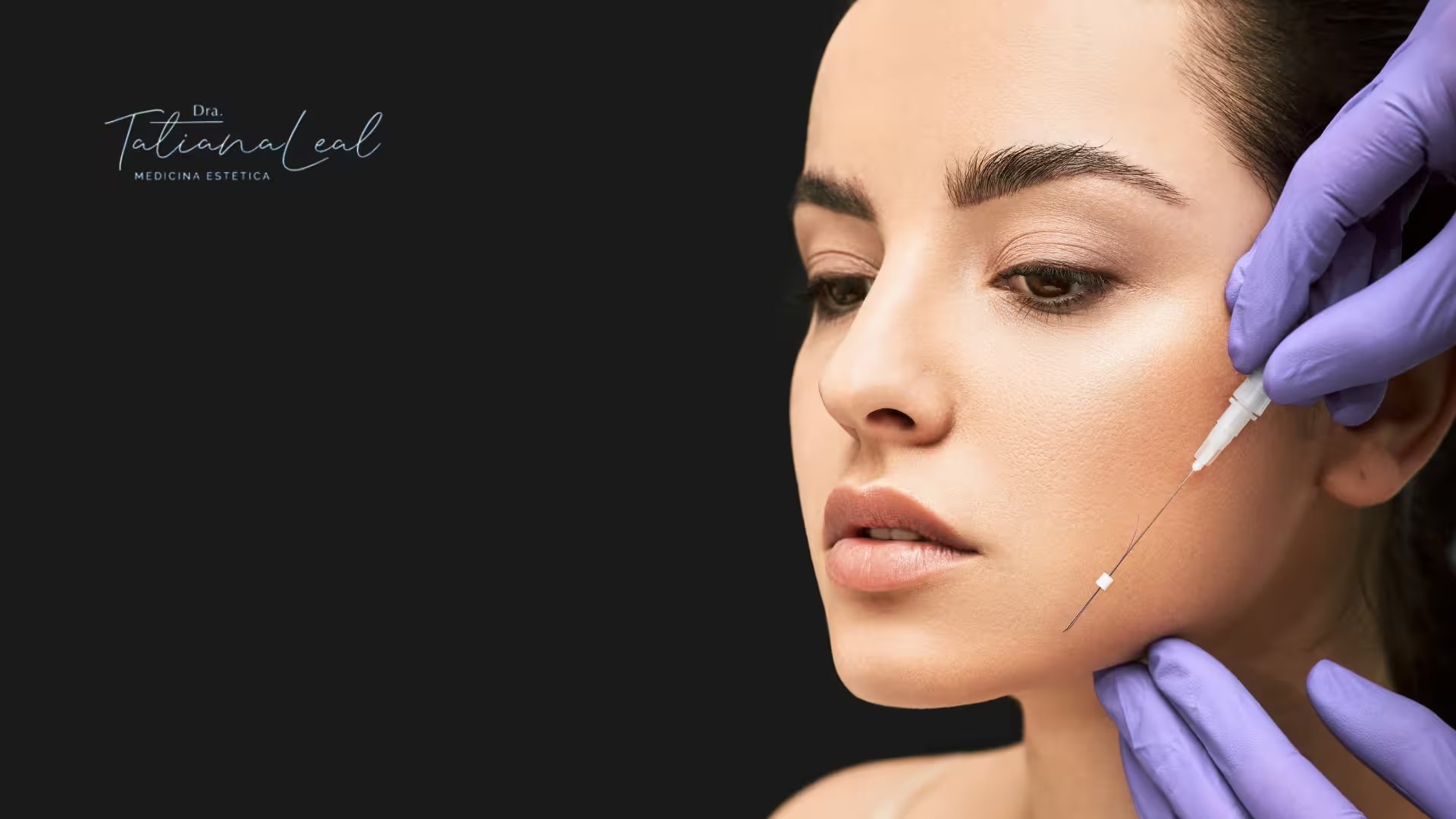
I’ll tell you a common history.
Maybe your history.
Sarah was 45 when she started noticing those subtle changes in her face that concern so many of us: a slight drop in the cheeks, a less defined jawline, and that feeling that her mirror reflection no longer conveyed the vitality she felt inside. As a high-level executive, her image was important, but the idea of undergoing surgery seemed excessive.
That’s when she discovered PDO thread lifting.
The perfect timing for thread lifting
When should you start thinking about thread lifting? The answer isn’t necessarily tied to a specific age, but rather to certain signs you begin to notice in your face. For Sarah, like many others, the first indicators were subtle yet significant.
The ideal time to consider this non-surgical treatment is usually when you start noticing:
- A mild to moderate loss of skin firmness
- Early signs of sagging in cheeks or neck
- A subtle but visible descent of facial contours
- The appearance of “barcode lines” or more pronounced wrinkles around the mouth
What’s interesting about thread lifting is that it works as both a corrective and preventive treatment. “Many of my patients,” notes Dr. Tatiana Leal, “achieve better results when they decide to act during the early stages of sagging, before changes become too pronounced.”
Recommended Age Table
| Age | Main Goal | Recommended Thread Type |
|---|---|---|
| 30-38 years | Preventive: “Baby Botox” + Threads | Smooth Threads (Monofilament) |
| 39-49 years | Mild Corrective: Define oval & cheekbones | Barbed Threads + Smooth |
| 50-60 years | Non-Surgical Lift: Strong traction | 3D/4D Barbed Threads or COGs |
| 60+ years | Complementary: Only if skin has good thickness | Combination with fillers |
Indications by Facial Zone
Not all threads work for the entire face. Here we explain what to expect depending on the area that concerns you:
- Droopy Eyebrows (Foxy Eyes): Ideal for lifting the tail of the eyebrow and opening the gaze.
- Cheekbones & Cheeks: Restores the “triangle of youth” by repositioning malar tissues.
- Nasolabial Folds: Softens the line from nose to mouth by tightening the cheek.
- Jawline (Jowls): The star indication. Defines the jaw border and reduces double chin.
- Neck: Treats mild sagging of neck skin (does not eliminate fat).
Thread lifts for eyes: Rejuvenate your gaze without surgery
Thread lifts can rejuvenate the eye area without surgery. Discover how they work, what they can correct, and if you're a candidate for this treatment.
Read moreSarah’s decision: why she chose thread lifting
For Sarah, like many active professionals, recovery time was a crucial factor. She couldn’t afford the weeks of downtime required by surgery, nor did she want dramatic changes that would be obvious to her colleagues and clients.
PDO thread lifting offered exactly what she was looking for: a procedure with natural yet effective results, that could be performed in less than an hour and allowed her to return to her normal life within days.
The technology behind the results
What makes thread lifting so effective? The key lies in its dual action. On one hand, it provides an immediate lifting effect that visibly improves facial contours. On the other, it stimulates natural collagen production, meaning results continue to improve over time.
The threads used are made of polydioxanone (PDO), a biocompatible material with a long history of medical use. This means the treatment is not only effective but also safe and predictable.
What can you really expect?
Unlike surgical treatments, PDO thread lifting offers subtle yet significant improvement. The changes are noticeable but natural, something Sarah particularly appreciated. “My colleagues noticed something different about me,” she tells us, “but they couldn’t pinpoint exactly what had changed. They just said I looked more refreshed and radiant.”
Results typically last between 8 months to a year, though this can vary depending on several factors, including:
- Your initial skin quality
- Your age and lifestyle
- Post-treatment care
- The number and type of threads used

Real dangers and risks of thread lifts: the unfiltered truth
As a physician, my responsibility is to be clear about the real dangers of thread lifts. It's not all rosy, and knowing the risks will protect you from bad decisions and inadequate professionals.
Read moreThe role of prevention
One of the lesser-known advantages of thread lifting is its ability to prevent premature aging. By stimulating collagen production, it not only improves the current appearance of your skin but also helps maintain its firmness in the long term.
Absolute and relative contraindications for thread lifting
Knowing the contraindications for thread lifting before booking your appointment is just as important as choosing the right doctor. There are two categories: absolute (the procedure cannot be performed under any circumstance) and relative (they require individual evaluation).
Absolute contraindications
You are not a candidate if you have any of these conditions:
- Pregnancy or breastfeeding: There are no safety studies for these stages, and the risk isn’t justified.
- Active infections in the treatment area: Severe inflamed acne, active cold sores, an active dental infection, or any infectious focus near the treatment zone.
- Diagnosed clotting disorders: Conditions that prevent normal blood clotting increase the risk of severe bruising.
- Active autoimmune disease: Lupus, active rheumatoid arthritis, or active scleroderma can alter healing and thread integration.
- Blood thinners that can’t be paused: Warfarin, heparin, or antiplatelet drugs that cannot be stopped for the time your doctor requires.
Relative contraindications (require evaluation)
These conditions aren’t an automatic “no,” but they do require a personalized evaluation:
- Extremely thin skin: Risk that the threads become visible or palpable.
- Severe sagging with excess skin: Threads don’t have the strength to lift large volumes of skin; surgery is the correct indication.
- Tendency toward keloids or hypertrophic scarring: This can affect how you respond to the procedure.
- Recent fillers or procedures: It’s recommended to wait at least 2-4 weeks for those materials to fully integrate.
- Unrealistic expectations: If you’re expecting the result of a surgical facelift, threads will be disappointing.
Making the right decision
If you identify with Sarah’s story and are considering thread lifting, the first step is a professional consultation. Every face is unique, and a successful treatment requires a personalized evaluation and a plan tailored to your specific needs.
To dive deeper into specific topics, I recommend reading about PDO, PCL, and PLLA thread types, thread lifting for eyes and eyelids, and neck and double chin treatment.
PDO thread lifting might be the ideal solution if you’re looking for:
- Natural and progressive results
- A minimally invasive procedure
- Quick recovery
- Long-lasting but not permanent improvement
- A treatment that can be done during your lunch break
Ready to discover if thread lifting is the right option for you? Schedule a consultation with our specialists and take the first step towards a more radiant version of yourself.
Want to learn more about this treatment?
Schedule your consultation with our doctors and discover the ideal treatment for you
Book your appointment * Limited spots this weekUpdated: January 2025
Disclaimer: Results may vary from person to person. All procedures are performed by certified doctors in our state-of-the-art facilities.
Thread Lift Aftercare: What You Need to Do Step by Step
Thread lift results depend both on the physician's technique and what you do in the following days. This guide accompanies you step by step: first hours, first week and the first month.
Read more
Frequently asked questions
What is the ideal age range to start considering thread lifts?
Most candidates are between 35 and 55 years old, when skin has early to moderate laxity but still retains enough elasticity to respond well to thread traction. Patients in their 30s may be treated preventively for subtle lifting, while those over 60 with significant sagging often achieve better results with surgery.
What facial conditions can thread lifts NOT effectively correct?
Thread lifts cannot address excess skin caused by significant weight loss, very deep jowls, or severely deflated cheeks that require volume restoration rather than mechanical lifting. They are also ineffective for correcting skin texture issues, hyperpigmentation, or dynamic wrinkles caused by muscle movement.
Who should choose a surgical facelift over thread lifts?
Patients with pronounced jowls, a heavy neck, or grade III–IV skin laxity generally achieve more predictable and lasting results with rhytidectomy (facelift surgery). If a consultation reveals that the degree of sagging exceeds what threads can mechanically correct, surgery is recommended to avoid an unsatisfactory outcome.
Can thread lifts be combined with other non-surgical treatments on the same visit?
Yes, threads are frequently combined with hyaluronic acid fillers, botulinum toxin, or skin biostimulators during the same session to address both laxity and volume loss simultaneously. However, certain energy-based devices like radiofrequency should be scheduled at least 4 weeks after thread placement to avoid displacing the threads.
What happens if threads are placed too early, before significant sagging develops?
Getting threads before meaningful laxity is present can lead to unnatural facial tension, visible dimpling under the skin, or an asymmetrical appearance that looks over-corrected on otherwise firm tissue. It also means the patient will need repeat treatments sooner, increasing cumulative cost without proportional benefit.
Why are thread lifts not recommended in some cases?
Thread lifts are not recommended when there is severe sagging with excess hanging skin (in that case a surgical facelift is the correct indication), when medical contraindications exist such as pregnancy, active infections or clotting disorders, or when the patient's expectations exceed what the treatment can achieve. In addition, most bad experiences seen online are not caused by the procedure itself, but by applications performed by non-medical personnel or with uncertified materials. In the hands of a certified physician and in the right candidate, it is a safe and effective procedure.
Are there medical conditions that disqualify someone from being a thread lift candidate?
Active skin infections, autoimmune connective tissue disorders, severe diabetes with poor wound healing, and current use of blood thinners or anticoagulants are among the main contraindications. A full medical history evaluation during consultation is essential to identify any factors that increase procedural risk.
Do thread lifts work the same in men as in women?
Yes, thread lifts are equally effective in men, although male facial anatomy requires an adapted technique: the skin is thicker, the muscles are more voluminous, and the aging pattern differs. The number of threads needed is usually higher, and the priority treatment areas are different (jawline, neck, malar area).