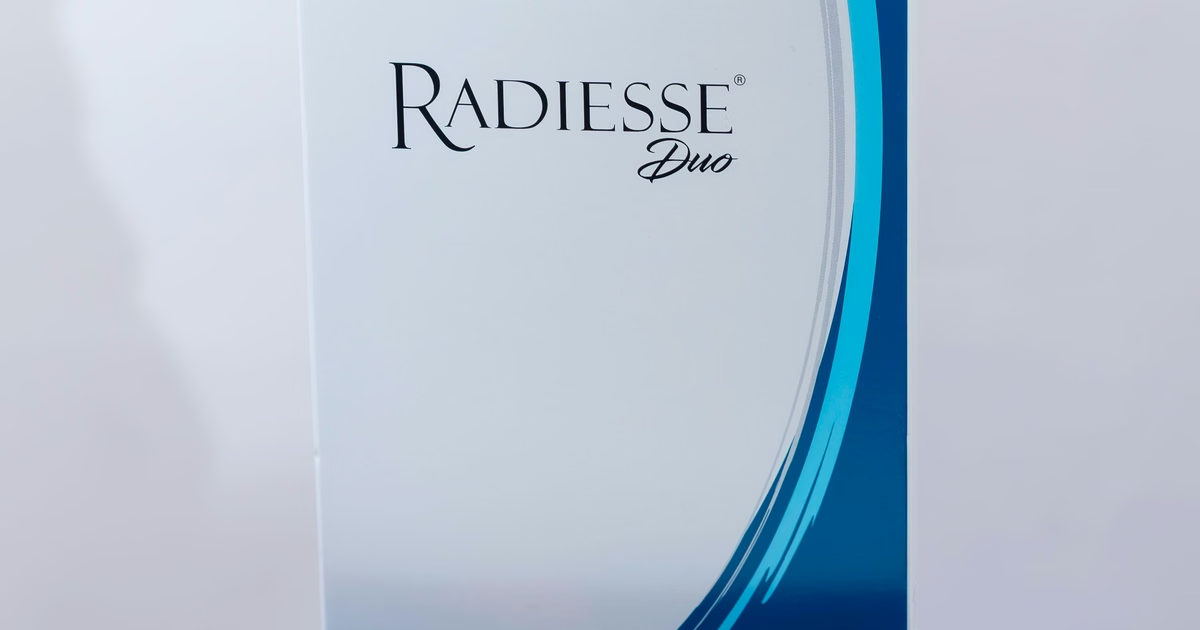
“What exactly is Radiesse?” is one of the questions I hear most often in my practice. The patient has seen it recommended by a friend, read about it in a forum or heard it mentioned alongside Sculptra, and she isn’t sure whether it is a filler, a biostimulator or both. The short answer is that it is both, and that double action is exactly what makes it useful in some cases and a poor choice in others.
What is Radiesse: calcium hydroxylapatite in a gel
Radiesse is an injectable product made by Merz Aesthetics. It is composed of calcium hydroxylapatite (CaHA) microspheres suspended in a carboxymethylcellulose gel. Calcium hydroxylapatite is the same mineral found in your bones and teeth, which is why the body recognizes it and breaks it down without a foreign-body reaction.
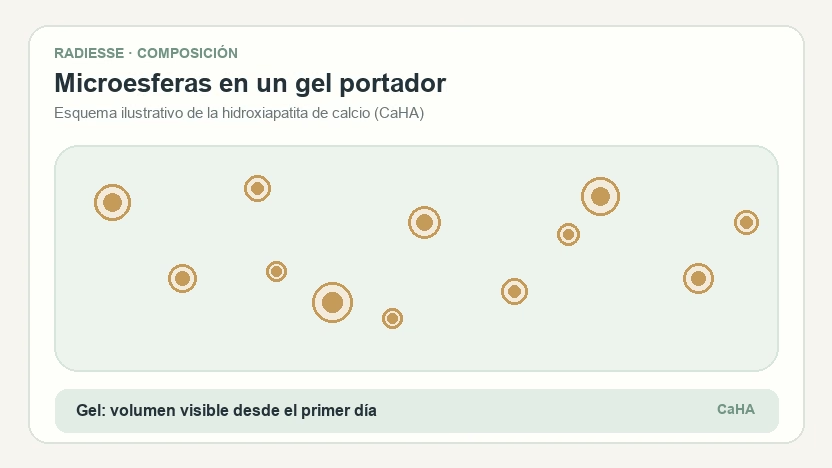
Each component has a different job:
- The gel takes up space at the moment of injection. It is what gives you visible volume from day one.
- The microspheres remain in the tissue as a scaffold. On them, fibroblasts, the cells that make collagen, are activated and produce new collagen over the following months.
Over time the gel is reabsorbed, but the collagen that formed around the microspheres is what sustains the result. Afterwards, the microspheres slowly break down into calcium and phosphate, which the body eliminates naturally.
How it works: immediate filling and biostimulation at the same time
This is the difference that confuses patients the most, so I’ll explain it with an example from my practice. When I treat a deep nasolabial fold with Radiesse, the patient leaves the clinic with a softer fold that same day: that is the gel. Between the second and third month the result looks firmer and more natural, because her own collagen is already at work: that is the microspheres.
That is why Radiesse is called a hybrid biostimulator. Sculptra, on the other hand, is a pure biostimulator: it gives no immediate volume and its entire effect depends on the collagen that forms over the following months. If you want the full comparison between the two, you’ll find it in my guide Sculptra vs Radiesse.
What is Radiesse used for
In my practice in Bogotá I use Radiesse for these indications:
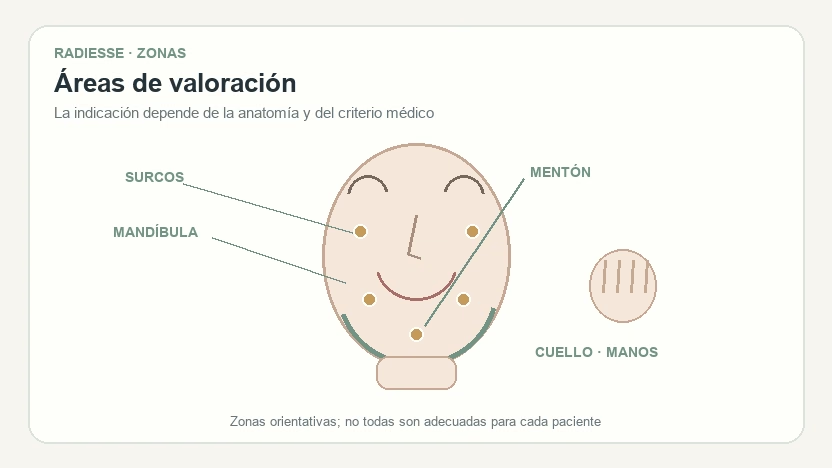
Face
- Deep nasolabial folds and marionette lines, where support is needed in addition to filling.
- Jawline and chin, to restore definition to the facial contour.
- Cheekbones with volume loss, to bring back projection without excess.
Neck Applied in a diluted form, Radiesse acts more as a biostimulator than as a filler: it improves the firmness and quality of the skin on the neck, the area that usually gives away age first. I explain the protocol on the Radiesse for the neck page and, if you are weighing your options, in Radiesse vs thread lifts for the neck.
Hands The back of the hand loses fat and reveals veins and tendons. Radiesse was approved by the FDA specifically for hand rejuvenation, and it is one of the treatments where I see the best results. I cover it in detail in Radiesse for hands.
Neck flaccidity: causes, warning signs, and the best treatments
The neck ages before the face. Discover why neck flaccidity occurs, how to recognize warning signs, and what are the most effective non-surgical treatments.
Read moreWhere I do NOT use Radiesse
Knowing where not to use it is as important as knowing where to use it:
- Lips: it is a dense product that can form nodules in a muscle that moves so much. For lips I use hyaluronic acid.
- Under-eye hollows and the periocular area: the skin is very thin and any irregularity shows. Here too, hyaluronic acid is the safe option, because it can also be dissolved.
- Patients who have never had a filler and want to “try one”: since Radiesse cannot be dissolved, I prefer to start with a reversible product.
How long does Radiesse last
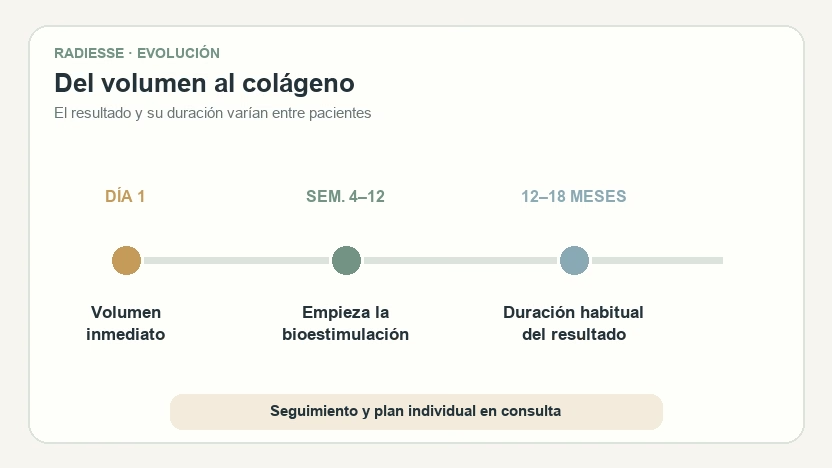
The effect of Radiesse lasts between 12 and 18 months. The volume from the gel shows from day one, and the collagen it stimulates starts adding up between weeks 4 and 12, which makes the result look increasingly natural.
How long it lasts depends on several factors:
- The treated area: areas with more movement metabolize the product faster.
- The amount applied: an insufficient syringe lasts less, because it provides less support.
- Your metabolism and habits: unprotected sun exposure, smoking and sudden weight loss speed up collagen loss.
Most of my patients have 1 or 2 sessions per area, 6 to 12 months apart, followed by maintenance roughly once a year.
Radiesse vs hyaluronic acid: the difference in one table
| Radiesse | Hyaluronic acid | |
|---|---|---|
| What it is | Calcium hydroxylapatite in gel | A molecule that retains water |
| Effect | Immediate filling + your own collagen | Immediate filling |
| Duration | 12 to 18 months | 6 to 18 months depending on the area |
| Can be dissolved | No | Yes, with hyaluronidase |
| Lips and under-eyes | Not used | Yes |
If you are torn between a filler and a biostimulator, I also recommend reading hyaluronic acid vs Sculptra, where I explain how I decide between filling and biostimulation.
Radiesse side effects and who should not use it
Radiesse has a very good safety profile when it is applied by an experienced physician. What to expect after the session:
- Common and temporary: mild swelling and tenderness to the touch, which settle within 24 to 48 hours, and sometimes small bruises at the entry points that take a few more days to fade.
- Uncommon: irregularities or palpable nodules. They are almost always due to a deposit that is too superficial; that is why I place it in deep planes and with a cannula.
- Rare but serious: vascular occlusion, which can happen with any injectable filler. It is prevented by knowing the anatomy, using a cannula in risk areas and injecting slowly.
A practical detail: calcium hydroxylapatite is visible on X-rays and CT scans. It does not interfere with diagnosis, but it is a good idea to tell your radiologist that you have Radiesse.
I do not recommend Radiesse during pregnancy or breastfeeding, if you have an active infection in the area, an allergy to any of its components or a bleeding disorder. With active autoimmune diseases I assess each case individually before deciding.
Aged hands: why it happens and how to rejuvenate them without surgery
Hands betray age even when the face looks young. Discover why they age earlier and what are the most effective non-surgical treatments to rejuvenate them.
Read moreWhat a Radiesse session looks like in my practice
- Assessment: I examine the area, your skin quality and your medical history, and I tell you how many syringes you need. If Radiesse is not the best option for your case, I will tell you.
- Preparation: I clean the area and apply topical anesthesia about 30 minutes beforehand so the session is comfortable.
- Application: I use a cannula in most areas, which reduces bruising and vascular risk. The application itself takes 30 to 45 minutes.
- Afterwards: you can return to your activities the same day. For the first 3 days I ask you to avoid intense exercise, direct sun, saunas and firm massage on the area.
About the price: at our clinic Radiesse costs from $2,000,000 COP per 1.5 ml syringe. The total cost depends on how many syringes your case needs, and I break it down area by area in how much Radiesse costs in Colombia. If you are traveling to Bogotá for treatment, keep in mind that our prices are in Colombian pesos and that the exact plan is defined in an in-person assessment.
My recommendation
Radiesse is an excellent tool when you need support and volume in a specific area and want the result to hold for more than a year: deep folds, jawline, neck and hands. It is not the option for lips, under-eye hollows or for anyone who prefers a reversible treatment. If you still don’t know whether a filler, Sculptra or Radiesse suits you better, that decision is best made in an in-person assessment, looking at your face in motion.
Dr. Tatiana Leal is an aesthetic medicine specialist in Bogotá, Colombia.
Sculptra vs. Radiesse: a complete guide to choosing the right biostimulator
Sculptra or Radiesse? Discover the key differences, their best-fit indications, and which one aligns with your aesthetic goals.
Read more
Frequently asked questions
What is Radiesse?
Radiesse is an injectable biostimulator made of calcium hydroxylapatite (CaHA): microspheres of a mineral the body already knows, suspended in a gel. The gel provides immediate volume and the microspheres stimulate fibroblasts to produce your own collagen over the following months.
What is Radiesse used for?
It is used to restore volume and firmness in areas where aging has hollowed or loosened the tissue: nasolabial folds, marionette lines, jawline, chin and cheekbones. Diluted, it is also used to tighten the skin of the neck and to rejuvenate the back of the hands. It is not used in the lips or under the eyes.
How long does Radiesse last?
The effect of Radiesse lasts between 12 and 18 months. The volume from the gel is visible from day one, and the collagen it stimulates sustains the result over that period. Most patients have 1 or 2 sessions per area, 6 to 12 months apart.
Is Radiesse the same as hyaluronic acid?
No. Hyaluronic acid is a filler that can be dissolved with hyaluronidase and does not stimulate collagen significantly. Radiesse fills and also stimulates collagen, and it lasts longer, but there is no antidote to dissolve it: that is why patient selection and technique are decisive.
What are the side effects of Radiesse?
The most common are mild swelling and tenderness that settle within 24 to 48 hours and, sometimes, small bruises that take a few more days to fade. Less common are irregularities or palpable nodules, almost always caused by placing it in a plane that is too superficial. The serious complication, which is uncommon, is vascular occlusion, a risk shared by all injectable fillers and prevented through anatomy knowledge and cannula technique.