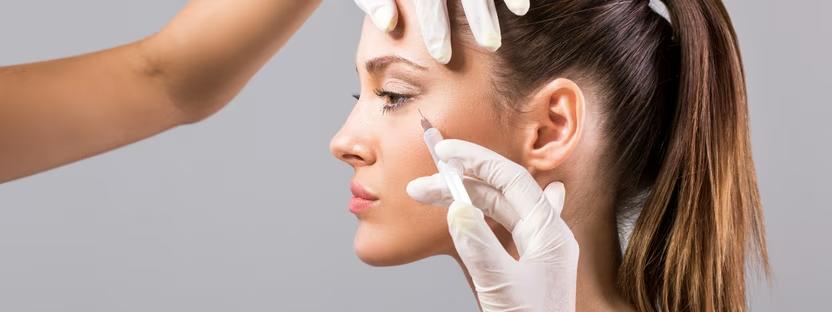
When a 24-year-old patient arrives at the consultation asking if she should start Botox, my answer is neither an automatic “yes” nor a “you’re too young.” It is an evaluative question: “Show me your glabella. Do you see anything here when you are not frowning?”
That simple observation — whether or not there are lines at rest — is the first signal I use to determine whether preventive Botox makes sense at that moment.
In short: there is no universal chronological age to start Botox. What determines the right moment is individual muscle activity, skin type, and the presence or absence of lines at rest. There are 23-year-olds who already have an indication, and 38-year-olds who still do not.
The mechanism that explains preventive Botox
To understand why Botox can be preventive, we first need to understand how permanent wrinkles form.
A permanent wrinkle does not appear out of nowhere — it is the result of thousands and thousands of repeated muscle contractions in the same area, over years. Every time you frown, raise your eyebrows, or make a facial expression, the muscle contracts and the skin over it folds. Initially, when skin is young and has abundant collagen and elastin, it stretches back completely. No trace remains.
Over time, that recovery capacity diminishes. Collagen decreases (1% per year since age 25), skin becomes less elastic. Then those repeated folds start to leave marks even when the muscle is at rest. That is a permanent wrinkle.
Preventive Botox interrupts this cycle. By reducing the intensity of muscle contractions, it reduces the number of “folds” the skin receives over time. The result: skin takes longer to develop permanent wrinkles.
Preventive Botox before 30: what is baby botox and how it really works
Baby botox uses very low doses to slow wrinkle formation without producing a 'frozen' effect. Here is the science behind the concept, which zones it covers, and why dose is everything.
Read moreThe signs that tell me preventive Botox makes sense
Sign 1: visible lines at rest (the most important)
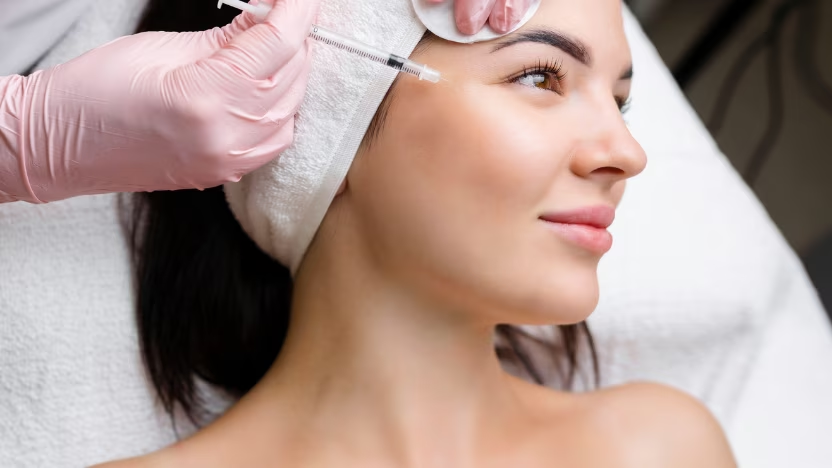
If you look in the mirror with your face completely relaxed — with no expression — and you already see lines in the forehead or glabella, those are resting lines. They indicate that the skin no longer fully recovers its position between expressions.
What does this mean? That the process of permanent wrinkle formation has already begun. Botox at this stage can stop progression, though it will not erase what is already established.
Sign 2: very high facial muscle activity
Some people have intrinsically more active facial musculature — they frown with a lot of force, have very marked facial expressions naturally. This is not bad in itself, but it does mean their muscles “work harder” and wrinkle formation may be earlier.
If you notice your expression lines are very marked even when making the expression, though they disappear at rest, it may make preventive sense to start with very low doses that soften (not freeze) expression.
Sign 3: family history of early wrinkles
Genetics matter. If your parents or grandparents had deep wrinkles from a young age, you have a higher probability of following a similar pattern. In these cases, an earlier preventive approach may be more beneficial.
Sign 4: habits that accelerate aging
Smoking, chronic sun exposure without protection, chronic sleep deprivation, persistent stress — all these factors degrade collagen and elastin faster. In patients with these risk factors, the preventive indication may be earlier.
When preventive Botox is probably premature
If you are 22–28 years old, your expression lines are only visible when making an expression (and disappear completely at rest), you have good skin elasticity and no significant accelerated aging risk factors — Botox is probably premature.
This does not mean you will never need it. It means that for now, your skin is doing its job perfectly and there is no clinical indication to intervene yet.
My recommendation in these cases: invest in sun protection, medical skincare (vitamin C, retinol under supervision), and delay Botox until there is a real signal.
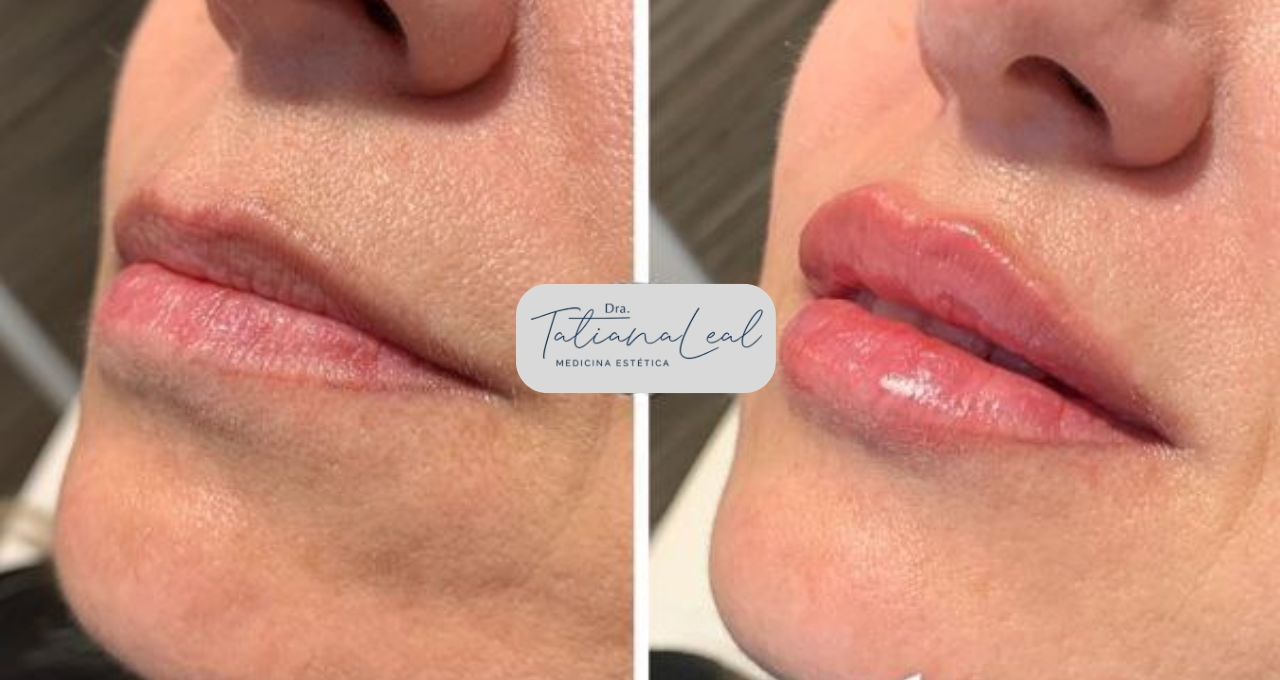
Expression Lines in the Mouth and Lips: Effective Treatment
We show you how to eliminate expression lines in the mouth and lips with effective and safe treatments.
Read moreMyths about Botox that need to be dispelled
“Botox makes you age faster if you stop”
Completely false. If you stop Botox, your face simply returns to its natural state of muscle activity. It does not age faster — it returns to aging at the rate it would have had without treatment.
“Preventive Botox freezes your face”
Preventive doses are significantly lower than corrective doses. The goal is not to paralyze — it is to soften. A young patient with well-applied preventive Botox should be able to make all facial expressions; just with less muscular intensity.
“Botox creates addiction”
Botox does not produce physical or chemical dependency. If a patient feels she “needs” Botox, it is for psychological reasons (she likes the result and wants to maintain it), not biological dependency.
“Once you start, you have to continue forever”
No. If at any point you decide not to continue, Botox is reabsorbed and the musculature returns to its previous state. There are no negative consequences for stopping treatment.
My protocol for young patients
When a young patient arrives at our clinic in Bogotá interested in preventive Botox, the process is:
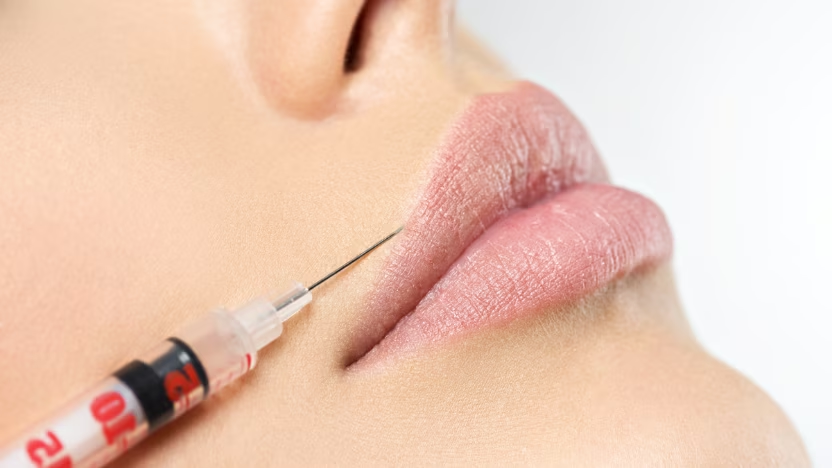
Evaluation of musculature at rest and in movement: I observe which zones have the most activity, whether there are resting lines, skin quality.
Risk evaluation: Genetic factors, habits, skin type, existing photodamage.
Expectations conversation: I explain exactly what Botox can and cannot do, how long it lasts, what doses we will use and why.
Low-dose protocol if indicated: In young patients in the preventive phase, I always start with the lowest doses that produce the desired effect. Better to stay conservative and adjust at the review than to go too far from the start.
Two-week review: To evaluate the result and adjust if necessary.
If you are considering whether preventive Botox makes sense for you, we invite you to an evaluation consultation where we can assess your specific case without commitment.
Dr. Tatiana Leal is an aesthetic medicine specialist in Bogotá, Colombia.

Botulinum toxin for bruxism: Stop teeth grinding without surgery
Botulinum toxin for bruxism: Effective treatment for teeth grinding and jaw clenching. Discover how to stop TMJ pain and protect your teeth.
Read more
Frequently asked questions
At what age can preventive Botox be started?
There is no universal minimum age. Preventive Botox usually makes sense between ages 25 and 35 for patients with high facial muscle activity who are already seeing lines at rest. What matters is not chronological age but muscle activity: if expression lines disappear completely at rest, preventive Botox is probably premature. If lines already remain at rest, it is time to consider treatment.
Does preventive Botox actually work to prevent wrinkles?
Yes, clinical evidence supports the concept of preventive Botox. The mechanism is clear: permanent wrinkles form through repeated muscle contractions in the same area over years. By reducing those contractions with Botox, the formation of permanent wrinkles is slowed. Studies have shown that patients who use preventive Botox have fewer deep wrinkles than same-age patients who did not.
Is preventive Botox at age 25 too young?
It depends on the case. At age 25 with deep lines at rest in the glabella or forehead, preventive Botox may be well indicated. At age 25 with lines that only appear when making an expression and disappear completely at rest, it is probably premature. Evaluation must be individualized. Age alone is not the criterion.