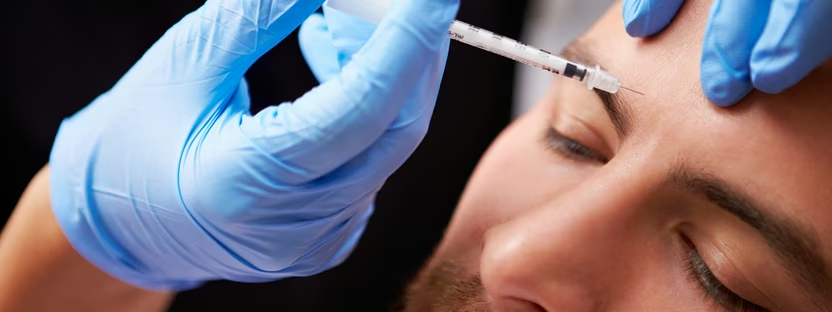
A question I frequently receive from patients who have had Botox elsewhere is: “What brand do you use?” And when I answer that we primarily use Botox and Dysport, the next question is usually: “And why those and not cheaper ones?”
It is a completely valid question. I want to answer it honestly and in the detail it deserves, because botulinum toxin selection is not a minor detail — it has real implications for safety, predictability, and result quality. If you are already considering treatment, here is botulinum toxin in Bogotá: price and assessment.
In short: Not all botulinum toxins are equal even if they share the same active ingredient. Differences in tissue diffusion speed, time to onset, and unit equivalence determine which brand is most appropriate for each facial zone. At our clinic we primarily use Botox and Dysport for their proven clinical track record and predictability — not because they are cheapest, but because they allow us to deliver consistent, safe results session after session.
The basics first: what is botulinum toxin and why are there different brands?
Type A botulinum toxin is a neurotoxin produced by the bacterium Clostridium botulinum. In aesthetic medicine, it is used in extremely small concentrations (nanograms) to temporarily block neuromuscular transmission in specific facial muscles, reducing their contractions.
What is colloquially called “Botox” is actually a family of products with the same basic mechanism but with important formulation differences:
Botox (onabotulinumtoxinA) — Allergan/AbbVie: The original. Approved for cosmetic use in the US since 2002. The toxin is stabilized with albumin and comes in lyophilized form.
Dysport (abobotulinumtoxinA) — Galderma: Second generation, approved in the US in 2009. Has accessory protein complexes with different profile than Botox, affecting its behavior in tissue.
Xeomin (incobotulinumtoxinA) — Merz: The “purified” toxin — has no accessory proteins. Approved in the US in 2011. Theoretically lower risk of generating neutralizing antibodies long-term.
Neuronox (botulinumtoxinA) — Medytox (Korea): Korean-manufactured toxin available in several Latin American countries. Less independent clinical study evidence compared to the above brands.
Other brands with less track record: Multiple botulinum toxin products from Asian manufacturing (primarily Chinese and Korean) exist with varying levels of evidence, health registry, and clinical history.

Expression Lines: What They Are, Why They Appear, and How to Eliminate Them Forever
Complete guide on expression lines: what they are, causes, effective treatments like botulinum toxin and how to prevent them.
Read moreThe differences that matter clinically
Difference 1: diffusion speed in tissue
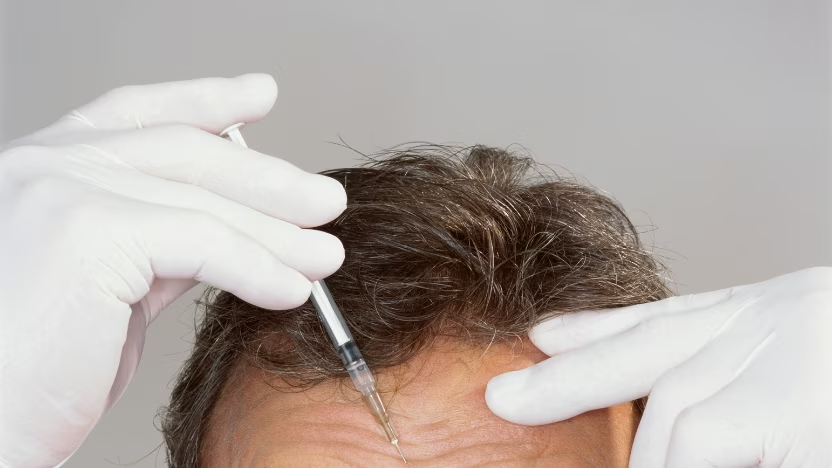
This is perhaps the most practical difference for the injecting physician:
Dysport, due to its accessory protein complex profile, tends to diffuse more in tissue than Botox. This has practical implications:
Dysport advantage: In large areas (like a large forehead) it can be advantageous because it covers more area with fewer injection points.
Dysport disadvantage: In small, high-precision zones (like the periocular area or upper lip), greater diffusion can lead to effects in adjacent muscles that were not intended to be treated.
For this reason, at our clinic:
- I prefer Dysport for the forehead and in patients with very active musculature where I want broader coverage
- I prefer Botox for high-precision zones (periocular area, lip, chin, masseter muscle)
Difference 2: time to onset of effect
Dysport tends to show its effect earlier than Botox:
- Dysport: visible effect in 1–2 days, maximum at 7–10 days
- Botox: visible effect in 3–5 days, maximum at 10–14 days
This may matter when a patient has an upcoming event and wants to see the result.
Difference 3: unit equivalence — it is not linear
This is a frequent point of confusion even among physicians:
The equivalence between Botox and Dysport is not 1:1. The approximate conversion is that 1 unit of Botox equals 2.5–3 units of Dysport. However, this equivalence varies by zone and goal.
A common error is applying this conversion mechanically. Clinical reality is more complex: in some zones, Dysport at the same “unit equivalence” can produce a greater than expected effect, precisely because of its greater diffusion.
Difference 4: clinical evidence and track record
Botox and Dysport have decades of clinical studies, long-term safety data, and millions of documented procedures. This evidence allows predicting product behavior with great precision.
Newer or less-established brands have fewer independent data available. They may be equivalent in efficacy and safety, but the evidence to affirm this with certainty is smaller.

Botulinum toxin for bruxism: Stop teeth grinding without surgery
Botulinum toxin for bruxism: Effective treatment for teeth grinding and jaw clenching. Discover how to stop TMJ pain and protect your teeth.
Read moreWhy price is not my main criterion
In Colombia, generic or less-established botulinum toxins can be significantly cheaper than Botox or Dysport. And I know this difference is reflected (or should be reflected) in what each clinic charges.
My decision to primarily use Botox and Dysport has a cost: our prices are not the lowest on the market.
But my reasoning is this:
Predictability: After years of injecting Botox and Dysport, I know exactly how they behave in each zone, at what dose, with what result. I do not have that certainty with products I know less.
Patient safety: I know exactly what each vial contains (lot certification, cold chain, storage). With unofficial distributors or products of lesser track record, that certainty is lower.
Predictable result for the patient: When I say “in 10 days you will see the result” or “you need X units for this effect,” I say it based on thousands of procedures with the same product. With a different product, there would be more uncertainty.
This does not mean other botulinum toxins are necessarily bad. It means that for me, predictability and documented safety have a value that is above cost.
My toxin selection protocol by zone
To be concrete and useful:
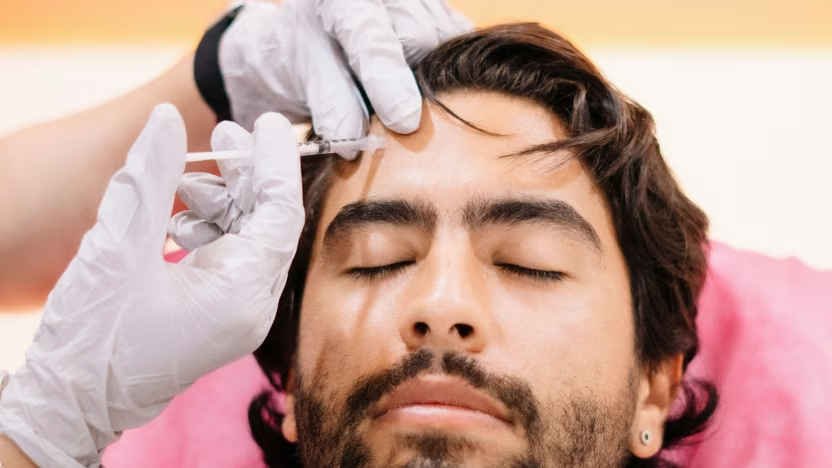
Forehead (horizontal lines): I prefer Dysport for its greater diffusion, which allows good coverage of a large area.
Glabella (glabellar lines, “the frown”): Depends on anatomy. In very active and wide corrugator muscles, Dysport. In cases where I want maximum precision, Botox.
Crow’s feet: Botox, due to the need for precision in a zone where the boundary with the inferior orbicular muscle matters.
Periocular area (brow ptosis, asymmetry correction): Botox exclusively. Precision is critical here.
Masseter (bruxism, slim face): Botox. Large, well-localized muscle, and I want a predictable and symmetrical result.
Lip (lip flip effect): Botox or Xeomin. Maximum precisio
Want to learn more about this treatment?
Schedule your consultation with our doctors and discover the ideal treatment for you
Schedule your treatment In-person consultation in Bogotá, Colombia (Av. Suba #114-59). Live in another city or abroad? Travel to your appointment or book a virtual assessment, same price.
Do Creams for Expression Lines Really Work? The Truth
Discover if creams really eliminate expression lines or if you need professional treatments like botulinum toxin.
Read more
Frequently asked questions
Are all botulinum toxins the same?
No. Although all are botulinum toxin type A, different brands (Botox, Dysport, Xeomin, Neuronox) have differences in formulation, size of accessory protein complexes, diffusion speed in tissue, unit conversion, and time to onset of effect. These differences are clinically relevant and affect how each product is used and what results it produces in different zones.
How many Dysport units equal one Botox unit?
The approximate equivalence is that 2.5–3 units of Dysport equal 1 unit of Botox (onabotulinumtoxinA). However, this equivalence is not linear in all zones — in some areas Dysport may behave with greater diffusion, which can be an advantage (large zones) or require greater precision (small zones like the periocular area).
What botulinum toxin brand does Dr. Tatiana Leal use at her clinic?
At our clinic we primarily use Botox (onabotulinumtoxinA, by Allergan/AbbVie) and Dysport (abobotulinumtoxinA, by Galderma), selecting between them based on the zone to be treated, the goal, and the patient's profile. In some specific cases we also use Xeomin (incobotulinumtoxinA, by Merz). The selection is clinical, not based on price.