
When a patient sits in my consultation to discuss facial fillers, an important part of the conversation always includes risks and side effects. Not to alarm them — hyaluronic acid has a very favorable safety profile — but because an informed patient makes better decisions and knows when something is normal and when to consult.
In short: hyaluronic acid is one of the aesthetic treatments with the best available safety profile. Common side effects are minor and temporary. Serious effects are rare but real, and their prevention depends almost entirely on the injector’s anatomical knowledge and technique.
Expected (normal) side effects
These are the effects I anticipate with all my patients and that do not constitute complications:
Post-injection swelling and redness
This is the most universal effect. Immediately after injection, the treated area shows visible swelling — especially evident in lips and under the eyes. This swelling:
- Is most intense in the first 24–48 hours
- Can make the result seem “exaggerated” initially
- Resolves spontaneously in 2–5 days depending on the zone
- Requires no specific treatment (local cold application can help in the first hours)
I always warn my patients not to judge the final result before the swelling has completely resolved — it can take up to a week in areas like the lips.
Bruising
Bruises are more frequent in highly vascularized zones such as the lips and periocular area. Incidence depends greatly on technique:
- With needles: higher bruising incidence due to the needle’s trajectory through vascularized tissues
- With cannulas: lower bruising incidence due to the blunt tip that displaces vessels instead of cutting them
At our clinic we use cannulas whenever the anatomy of the zone permits. Bruises that occur generally resolve in 7–14 days.
Post-procedure sensitivity and pain
It is normal to feel sensitivity in the injected zone for 2–5 days. Lips are especially sensitive. Pain when pressing on the zone can last up to a week. Over-the-counter analgesics (acetaminophen) are sufficient if the discomfort requires it.
Transient asymmetry
Initial edema can create a temporary asymmetry that does not reflect the real result. The definitive evaluation of symmetrical results is done at 2–3 weeks, when edema has completely disappeared.

Facial Treatment Prices in Colombia 2026: What Nobody Tells You
Learn the updated prices of facial treatments in Colombia: biotechnology and cutting-edge treatments. Information verified by specialists.
Read moreInfrequent side effects (requiring attention)
Tyndall effect
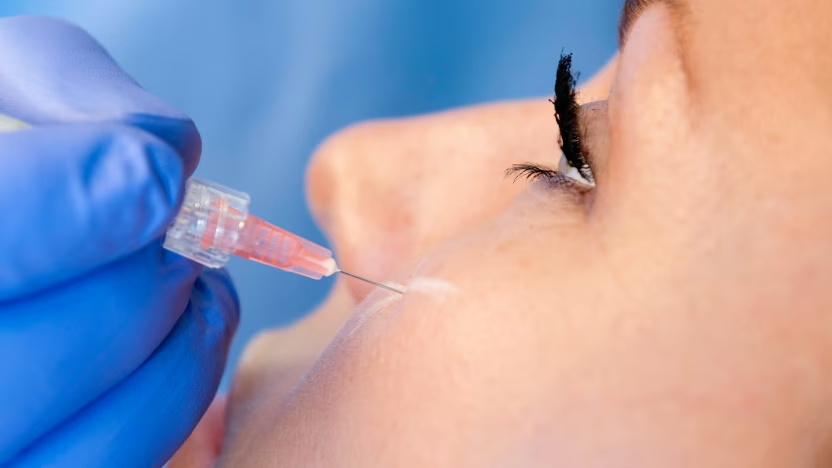
A bluish discoloration visible under the skin that occurs when hyaluronic acid has been placed too superficially in areas of very thin skin, especially under the eyes.
Hyaluronic acid scatters light of a certain wavelength similarly to how the atmosphere scatters blue light (hence the name, after physicist John Tyndall).
How it is prevented: using low-viscosity products in the periocular area and placing them in the correct plane (not too superficial). At our clinic, under-eye treatment is always done with cannula and products specifically formulated for this area.
How it is corrected: with hyaluronidase injected in the affected area. Hyaluronidase dissolves hyaluronic acid in 24–48 hours.
Late nodules
May appear weeks or months after treatment. They have several possible causes:
Non-inflammatory nodules: generally from migration or irregular product distribution. They feel like small balls under the skin. They are treated with massage or, if persistent, with hyaluronidase.
Inflammatory nodules (biofilm): a more serious complication related to formation of a bacterial film around the product. It is treated with specific antibiotics and sometimes with hyaluronidase.
Local infection
While infrequent, it can occur if the skin was not adequately prepared or if there is a bacterium in the injection area. It presents with heat, redness, pain, and possibly secretion. It requires antibiotics and sometimes drainage.

Lip Fillers: Everything You Need to Know Before Taking the Step
Discover everything about lip fillers: from modern techniques to expert advice for achieving natural, long-lasting results.
Read moreRare but serious side effects
These are the effects that physicians who inject hyaluronic acid keep in mind during every procedure because, while infrequent, they are the most important from a safety standpoint:
Vascular occlusion (the most serious risk)
The most serious complication of hyaluronic acid filling is occlusion of a blood vessel — when the product is inadvertently injected into a vessel or externally compresses it.
If an artery supplying blood to an area of skin is occluded, that skin can suffer necrosis (tissue death) if the occlusion is not treated immediately.
Anatomically higher-risk zones: the glabella (between the eyebrows), nasal dorsum, and periorbital zone, where arteries are small-caliber and have anastomoses with vessels irrigating the eye.
Warning signs: acute and immediate pain during injection, sudden skin pallor in the injected area, skin with “mottled” coloration.
Treatment: high-dose hyaluronidase injected immediately throughout the entire zone. At our clinic we always have hyaluronidase available in every filler session.
How it is prevented:
- Deep anatomical knowledge of the zone to be treated
- Aspiration technique before injecting in risk zones
- Use of cannulas in zones of high vascular risk
- Slow injection in small volumes
- Injector’s experience
Blindness (extremely rare complication)
In very exceptional cases, occlusion of vessels communicating with the ophthalmic vessels can produce vision loss. It is the most serious complication described with facial fillers.
Its incidence is extremely low (few cases reported worldwide in millions of procedures), but it is the reason why physicians who inject need specific training in managing filler-related emergencies.
Zones where risk is highest: glabella, nasal dorsum, temples, periorbital area.
The role of technique in prevention
Most serious hyaluronic acid complications are preventable with correct technique. This explains why the injector’s profile matters so much:

Anatomical knowledge: Knowing exactly where vessels and nerves are in each facial zone.
Slow technique and aspiration: Not injecting quickly. Aspirating before injecting in risk zones.
Use of cannulas: Blunt-tip cannulas reduce the risk of vascular perforation.
Small volumes: Injecting less volume at each point reduces the risk of vascular compression.
Availability of hyaluronidase: Essential in any filler session.
At our clinic in Bogotá, Dr. Tatiana Leal follows strict safety protocols in every hyaluronic acid session. If you are evaluating where to have this treatment, we invite you to learn about hyaluronic acid treatments at our clinic and resolve all your questions in a personalized consultation.
Dr. Tatiana Leal is an aesthetic medicine specialist in Bogotá, Colombia. This information is educational and does not replace individual medical consultation.

Aged hands: why it happens and how to rejuvenate them without surgery
Hands betray age even when the face looks young. Discover why they age earlier and what are the most effective non-surgical treatments to rejuvenate them.
Read more
Frequently asked questions
What are the normal side effects of hyaluronic acid?
Normal and expected side effects include: redness and swelling in the injected area (lasting 24–48 hours), sensitivity to touch in the first days, small bruises (especially in lips and under-eyes, may last 7–10 days), and mild transient asymmetry from initial edema. These are expected effects, not complications.
What is the Tyndall effect in hyaluronic acid and how is it corrected?
The Tyndall effect is a bluish discoloration visible under the skin that occurs when hyaluronic acid is placed too superficially in areas of thin skin (especially under the eyes). It is produced by light scattering in the tissue. It is corrected with hyaluronidase (an enzyme that dissolves hyaluronic acid) applied to the affected area.
What are the signs of a serious complication after hyaluronic acid?
Serious warning signs include: intense disproportionate pain immediately post-injection, pallor or mottled skin discoloration (may indicate vascular compression or injection), vision loss or blurred vision (emergency), nodules that do not disappear after several weeks, and signs of infection (heat, fever, pus). At any of these signs, seek medical attention immediately.