
When a patient says “I want hyaluronic acid,” the question I always ask is: “In which zone? And what result are you looking for?” Because hyaluronic acid is not a unitary treatment — it is a set of different techniques, with different products, for different facial zones, each with its own logic and considerations.
In short: hyaluronic acid can be applied in almost any zone of the face, but each area requires a specific product (firmness, viscosity), a specific technique (needle vs. cannula, injection depth), and produces results with a particular timeline and duration.
The principle guiding zone selection: the triangle of youth
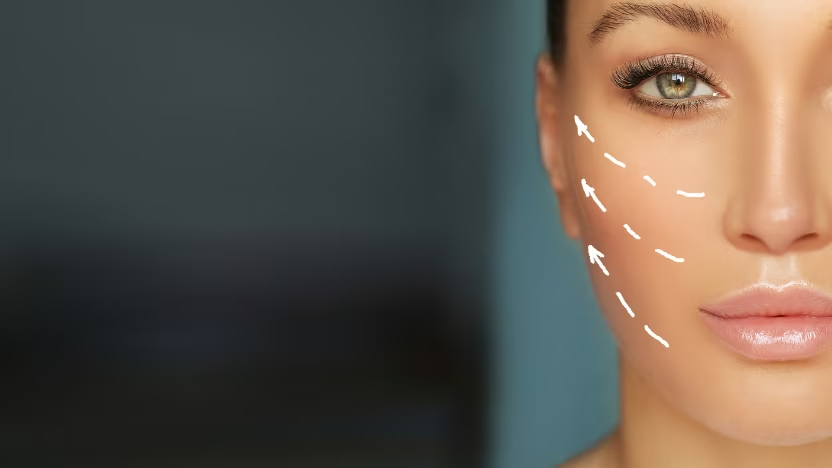
Before going zone by zone, it is important to understand the concept that guides my facial filling work. A young face has abundant volume in the upper portion (temples, cheeks) and less volume in the lower portion. Over the years, volume migrates downward: gravity and fat reabsorption cause the weight of the face to concentrate in the lower third, creating folds, grooves, and loss of definition.
Hyaluronic acid can restore this “triangle of youth” by replenishing volume where it was lost and redistributing facial architecture. This is what differentiates a well-planned filler from one that merely “fills wrinkles.”
Zone 1: lips — volume, definition, and hydration
Lips are the most requested filler zone, especially in younger patients. There are several distinct indications:
Volume: Increasing volume in the upper lip, lower lip, or both. Low-viscosity hyaluronic acid (Juvederm Volbella, Restylane Kysse type) is ideal for natural results.
Border definition: The vermilion border can be made more defined without necessarily adding volume. Ideal for lips that have lost definition with age.
Internal hydration: Some products are specifically formulated to bring hydration to the lip without volume. Ideal for dry or cracked lips.
What you should know before:
- The visible volume immediately post-injection is greater than the final result (there is initial edema)
- Lips are the most uncomfortable zone during infiltration — we routinely use topical anesthetic cream
- Average duration in lips is 6–8 months, less than other zones due to constant mobility
Typical volume: 0.5–1 ml for a visible but natural difference. More than 1 ml in lips tends to look disproportionate except in specific cases.

Aged hands: why it happens and how to rejuvenate them without surgery
Hands betray age even when the face looks young. Discover why they age earlier and what are the most effective non-surgical treatments to rejuvenate them.
Read moreZone 2: cheeks — projection and volume restoration
Cheeks are, in my experience, the zone where hyaluronic acid produces the greatest visual impact with the least product volume. Cheek filling “lifts” the middle facial third visually, attenuates nasolabial folds, and restores the triangle of youth.

Technique: We use high-viscosity, high-cohesivity hyaluronic acid (Juvederm Voluma, Restylane Lyft type) that gives projection and structural support. Injection is usually done in a deep plane, over the cheekbone, for a natural and long-lasting result.
What you should know:
- The result is immediate and very satisfying
- Duration is among the longest: 12–18 months
- Cheek filling can give the sensation of “facial lifting” even without Botox
Typical volume: 1–1.5 ml per side (2–3 ml total)
Zone 3: nasolabial folds — fold attenuation
Nasolabial folds (the “smile lines”) are one of the most consulted zones for patients over 40. However, it is important to understand that a deep fold is not always best corrected by filling the fold directly — sometimes the cause is volume loss in the cheeks, and that is the area to treat.
When I fill the fold directly: when the fold is deep and cheek volume loss has already been corrected or is not the dominant factor.
Product used: Intermediate-viscosity hyaluronic acid that integrates well in this plane without creating a “sausage” effect (visible excess product).
Duration: 12–15 months
Typical volume: 0.5–1 ml per side
Zone 4: under-eyes and tear trough — the most delicate treatment
Under-eye filling (the “tear trough” area, the depression between the lower eyelid and the cheek) is one of the treatments that gives patients the greatest satisfaction, but also the one requiring the most precision and care.
Why it is a special zone: Skin under the eye is very thin and the area has high mobility and high vascularization. A poorly placed product or one with incorrect characteristics can produce the Tyndall effect (bluish coloration visible under the skin) or significant bruising.
What I use in this zone: exclusively low-viscosity, high-hydrophilicity products, specifically formulated for this area (Restylane Eyelight, Belotero Balance). Cannula technique routinely used to minimize bruising.
Realistic expectation: Improvement of dark circles due to shadow effect (when there is a depression), does not eliminate dark color of vascular or pigmentary origin.
Duration: 9–12 months
Typical volume: 0.3–0.5 ml per eye (very little product, high precision)

Hyaluronic acid vs Sculptra: how Dr. Tatiana Leal decides which to recommend
Hyaluronic acid fills immediately. Sculptra stimulates your own collagen over months. They are different tools for different goals — and sometimes the best answer is to combine them.
Read moreZone 5: chin — projection and facial harmony
The chin is a zone that has become enormously popular in recent years, and for good reason: adequate chin projection improves the profile noticeably without appearing like a “filler.”
Most frequent indications:
- Retracted chin that visually shortens the lower third
- Chin asymmetries
- Loss of projection with age
Technique: High-viscosity hyaluronic acid in deep plane, over the bone. At our clinic, this treatment is always done with precise anatomical vision guidance.
Duration: 12–18 months
Typical volume: 0.5–1 ml
Zone 6: jawline and mandibular angle — definition
Jawline definition is one of the most marked trends since 2022 and continues in 2026. A well-defined mandibular angle provides structure, harmony, and a younger facial contour.

Indications:
- Loss of mandibular angle definition with age
- Naturally less defined jaw that the patient wishes to improve
- Asymmetry between both angles
Special considerations: The jawline is an anatomically complex area with important nerves. Precise anatomical knowledge is essential here. I use cannulas for most of this zone.
Duration: 12–18 months
Typical volume: 1–2 ml per side depending on the goal
Zone 7: temples — upper volume restoration
Temples are the most “forgotten” zone of facial filling, but their volume loss is very visible in people over 45–50. Concave temples give an aged and unwell appearance to the face that filling corrects very satisfyingly.
Indication: Visible temporal volume loss with a concave appearance of the temple.
Duration: 12–18 months (high-duration zone due to low mobility)
How I plan filling: the “facial harmonization” approach
At our clinic in Bogotá, Dr. Tatiana Leal does not work zone by zone in isolation but with a global facial harmonization approach. This means:
- Evaluating the face as a whole before deciding which zones to treat
- Prioritizing zones with the greatest impact on overall harmony
- Defining the correct volume so results are proportional
- Planning treatment in phases if multiple zones are to be treated
To find out which zones would be most beneficial in your specific case and learn about hyaluronic acid treatments available at our clinic, we invite you to schedule your evaluation consultation.
Dr. Tatiana Leal is an aesthetic medicine specialist in Bogotá, Colombia.

Hyaluronic acid price in Colombia 2026: everything you need to know
Hyaluronic acid in Bogotá ranges from $400,000 to $1,500,000 COP per syringe depending on the brand and zone. Here is what determines the price, which brands are available, and how to avoid making the wrong choice.
Read more
Frequently asked questions
In which areas of the face is hyaluronic acid applied?
Hyaluronic acid can be applied in virtually any area of the face: lips (volume and definition), cheeks (projection and filling), nasolabial folds (line attenuation), under-eyes and tear trough (hydration and gentle filling), chin (projection and definition), jawline (mandibular angle definition), temples (volume restoration), and forehead (horizontal line smoothing).
How much hyaluronic acid is needed for each facial zone?
Approximate volumes per zone are: lips (0.5–1 ml), cheeks (1–2 ml per side), nasolabial folds (0.5–1 ml per side), under-eyes (0.5–1 ml total), chin (0.5–1 ml), jawline (1–2 ml per side). The exact volume depends on the degree of volume loss and the desired result. A standard hyaluronic acid syringe contains 1 ml.
Which facial zone responds best to hyaluronic acid?
All zones respond well when treatment is correctly indicated and executed. Cheeks, chin, and jawline tend to give very satisfying results because of their impact on overall facial harmony. Lips are what most patients seek but also require the most precise technique for a natural result.