
One of the most frequent questions I receive about hyaluronic acid is: “How long will it last for me?” The honest answer is that it depends — on the zone, the product, your metabolism, and several lifestyle factors you may or may not be able to control.
In short: hyaluronic acid duration varies between 6 and 18 months depending on the treated zone. Lips have the shortest duration (6–8 months) due to high mobility. Lower-mobility zones like cheeks, chin, or temples can last 12–18 months.
Why hyaluronic acid is reabsorbed
Hyaluronic acid is a natural molecule in the body. The version injected for aesthetic purposes is a stabilized (cross-linked) version that takes longer to degrade than natural endogenous hyaluronic acid. However, the body’s hyaluronidase enzymes eventually degrade it, just as they degrade native hyaluronic acid.
This degradation process varies in speed according to:
- The area of application: more mobility = more mechanical stress = faster degradation
- Product type: greater cross-linking density = greater resistance to degradation
- Individual factors: metabolism, circulation, lifestyle habits

Hyaluronic acid facial side effects: what is normal and what is not
Hyaluronic acid has an excellent safety profile when used correctly. The most common side effects are temporary and minor. Serious ones are rare but real — and prevention depends almost entirely on the injector's anatomical knowledge and technique.
Read moreDuration by zone: real data
Lips: 6–8 months
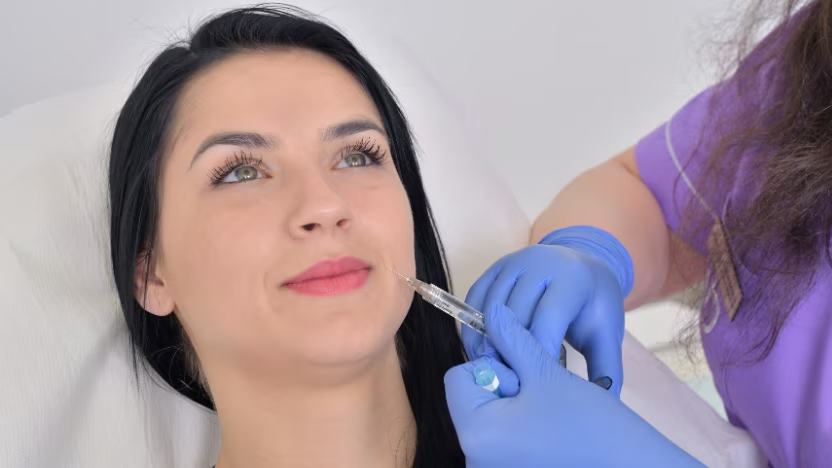
Lips are the shortest-lasting zone for clear anatomical reasons:
- Lips move constantly (speech, chewing, gestures)
- Blood circulation is very active in the lips
- Lip skin has high cell turnover
At our clinic, for some patients with very active metabolism who notice rapid reabsorption in lips, we opt for products specifically formulated for this zone with greater resistance to degradation (such as Juvederm Volift or Restylane Kysse in its denser formulation).
When to touch up: When the volume or definition is no longer what is desired. There is no fixed calendar — it is when the patient perceives it necessary.
Nasolabial folds: 12–15 months
Folds have intermediate duration. The zone has less mobility than lips but more than cheeks. Product in the folds works in superficial and intermediate planes where metabolism is active.
Cheeks: 12–18 months
Cheeks are among the longest-lasting zones for several reasons:
- The zone has relatively low mobility
- Product is placed in a deep plane (over the bone) where metabolism is lower
- High-viscosity products with high resistance to degradation are used (Juvederm Voluma, Restylane Lyft)
Chin and jawline: 12–18 months
Similar to cheeks — they are relatively low-mobility zones where deep product holds well. The mandibular angle in particular is a zone of excellent durability.
Under-eyes / tear trough: 9–12 months
Products used in under-eyes are low-viscosity (due to the area’s thinness), making them somewhat more susceptible to degradation. However, being a low-mobility zone, duration is reasonable.
Temples: 15–18 months
Temples are among the most durable zones. Low mobility, deep plane, and high-viscosity product = maximum durability.
Factors that accelerate reabsorption
Fast metabolism
This is the most difficult individual factor to modify. People with a higher basal metabolic rate (generally lean, very active people) tend to reabsorb hyaluronic acid faster. In these cases, we generally opt for higher-density products and discuss shorter duration expectations.
Intense, frequent physical activity
Intense physical activity elevates metabolism acutely and chronically and improves circulation, which can accelerate enzymatic degradation of hyaluronic acid. This is not a reason to stop exercising — it is information for managing expectations.
High-performance athletes who exercise intensely daily often see somewhat shorter duration.
Sun exposure without protection
UV radiation produces free radicals that can degrade hyaluronic acid. Additionally, intense solar heat can increase hyaluronidase activity. SPF 50 sun protection is a recommendation I always give post-filler, not only for the filler’s sake but for overall skin health.
Smoking
Tobacco reduces peripheral circulation and induces a state of chronic oxidative stress that can compromise filler longevity. Additionally, the repeated mechanical motion of smoking on the lips is one of the factors that specifically accelerates reabsorption in that zone.
Chronic anti-inflammatory medications
NSAIDs (ibuprofen, naproxen) taken chronically can interfere with the matrix proteins surrounding hyaluronic acid. This effect is not major, but in patients who take them regularly it may be a factor.
Product type used
Not all hyaluronic acids are equal. Differences between products directly affect duration:
- Greater cross-linking density: Greater resistance to hyaluronidases, longer duration
- Hyaluronic acid concentration: Higher concentration generally implies greater durability
- Presence of incorporated anesthesia: Lidocaine does not affect duration
At our clinic in Bogotá, product selection is not arbitrary — I choose the specific product based on the zone, the desired result, and the patient’s profile.

Thread lifts vs other facial treatments: Which to choose?
There are many treatments to rejuvenate without surgery. Thread lifts, HIFU, radiofrequency, or fillers? I explain the differences so you can choose correctly.
Read moreThe myth of “indefinite duration”
I want to be direct about something I see in some centers’ advertising: hyaluronic acid does not last “indefinitely” or “forever.” If you see this promise, it is a warning sign.

There is a situation that can create confusion: in very low-mobility zones (such as deep temples), small amounts of high-density hyaluronic acid can persist for several years. But even in those cases, it eventually gets reabsorbed.
What is possible is that, after several filler cycles in the same zone, the effect “lasts longer” because tissue support has been built up over time. But that is not that it lasts “forever” — it is that the tissue has adapted and touch-up frequency may be lower.
When is it time to touch up?
My recommendation is always the same: when the patient perceives the result is no longer what they desire. There is no fixed “expiration date.” Some patients prefer to touch up when they notice any result loss; others wait until they are closer to their baseline.
What I do recommend is not waiting until volume has completely disappeared — touching up with some residual product typically requires less total volume and produces more natural results.
To learn about facial hyaluronic acid treatments available at our clinic and plan your filler protocol, we invite you to schedule your consultation.
Dr. Tatiana Leal is an aesthetic medicine specialist in Bogotá, Colombia.

What is Hyaluronic Acid Facial Filler? Complete Guide to Dermal Fillers 2026
What is hyaluronic acid facial filler? Dr. Tatiana Leal explains how dermal fillers work, which facial areas they treat, whether hyaluronic acid is reversible with hyaluronidase, and which INVIMA-approved brands to use in 2026.
Read more
Frequently asked questions
How long does hyaluronic acid last in the lips?
In the lips, hyaluronic acid typically lasts 6 to 8 months. It is the shortest-lasting zone because lips have high mobility (speech, gestures, chewing) and more active blood circulation, which accelerates enzymatic degradation of hyaluronic acid.
What factors make hyaluronic acid last less time?
The main factors that accelerate hyaluronic acid reabsorption are: fast metabolism, frequent intense physical activity, sun exposure without protection, smoking, certain medications (especially chronically taken anti-inflammatories), the treated area (high mobility = shorter duration), and the type of product used (lower density = shorter duration).
Can I know in advance how long hyaluronic acid will last for me?
Not precisely, because duration depends on individual factors that vary. However, clinical evaluation can give a reasonable estimate based on your area to be treated, skin type, lifestyle habits, and the product to be used. In the first session we always discuss these expectations with the patient.