More and more patients arrive at the consultation having purchased home-use radiofrequency devices, influenced by social media or looking for a complement between sessions. My position on this is honest: home devices and professional medical equipment are completely different product categories, and confusing them leads to incorrect expectations.
In short: home facial radiofrequency can be a useful superficial maintenance complement, but it does not substitute professional treatments. The reason is fundamentally technical: it is not the same technology, nor the same power level, nor does it produce the same type of tissue contraction.
The technical difference that changes everything: power
This is the statistic that most impacts my patients when they hear it:
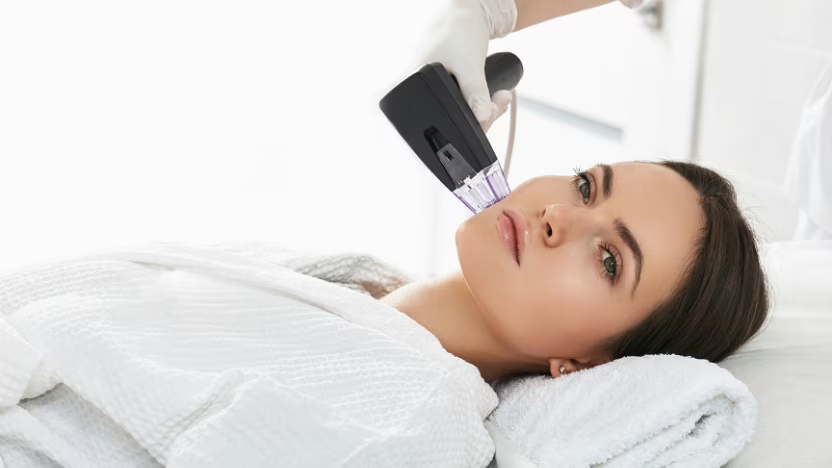
- Home-use radiofrequency devices: emit between 2 and 5 watts (W) of power
- Professional medical equipment (Thermage, EndyMed, InMode): emit between 50 and 200 watts (W)
That is a difference of between 10 and 100 times. This power difference is not arbitrary — it exists for regulatory safety reasons. Bodies that regulate medical devices in Europe (CE marking) and in the United States (FDA) impose strict limits on the maximum power a device can have for use without medical supervision.
Why power matters
For radiofrequency to stimulate collagen production, it needs to raise the temperature of deep dermal tissue to between 42 and 44°C. This temperature must be maintained for a determined time for fibroblasts to respond and produce new collagen.
With 2–5 watts, the heat generated barely penetrates 1–2 mm below the skin surface. This can produce a superficial effect of hydration and texture improvement, but rarely reaches the deep dermis where mature collagen lives.
With 50–200 watts and the epidermal cooling systems that medical devices have, heat can penetrate up to 4–6 mm, reaching the layers where collagen is effectively stimulated.
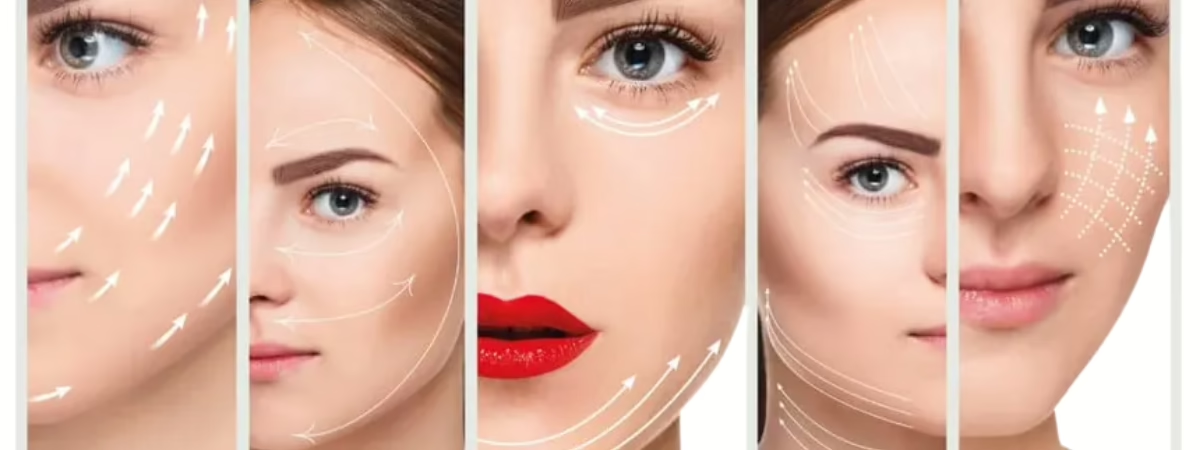
HIFU Facial vs Facial Radiofrequency: Differences, Benefits and How to Choose
Can't decide between HIFU facial and facial radiofrequency? Dr. Tatiana Leal explains the key differences, who each treatment is best for, and how to combine them for maximum results — all at Bogotá prices.
Read moreWhat are home devices actually useful for?
I do not want to completely discredit home devices — they have real uses if employed with correct expectations:
Improved superficial hydration: The gentle heat from home devices can temporarily improve superficial circulation and absorption of topical products.
Superficial maintenance between sessions: Some patients at our clinic use home devices between professional sessions as a complement. In that context, there may be a skin surface maintenance effect.
Lymphatic stimulation: The movement of the head and gentle heat can aid facial microcirculation.
What they are NOT useful for (honestly):
- Do not produce the level of neocollagenesis needed to genuinely improve firmness
- Do not reduce moderate or severe laxity
- Do not reach the temperature needed to remodel deep collagen
- Do not have the same effect as a professional session
Types of home devices and their differences
The home market has different categories:
Budget monopolar RF devices ($30–100 USD): The most basic. Very limited power, no control thermostat. The most common on online marketplaces. High quality variability.
Mid-range bipolar RF devices ($100–300 USD): Better engineering, some include LED light or galvanic modes. May have a slightly larger superficial effect. Examples: NuFace, MYOLIFT, Korean brand devices.
Home-use fractional RF devices ($300–800 USD): The most advanced level of the home market. Some models have very-low-depth microneedles combined with RF. Still, power is a fraction of medical devices.
Professional medical equipment (>$5,000 USD): Only available with medical training. Thermage, Morpheus8, EndyMed, InMode. The category with robust clinical evidence.
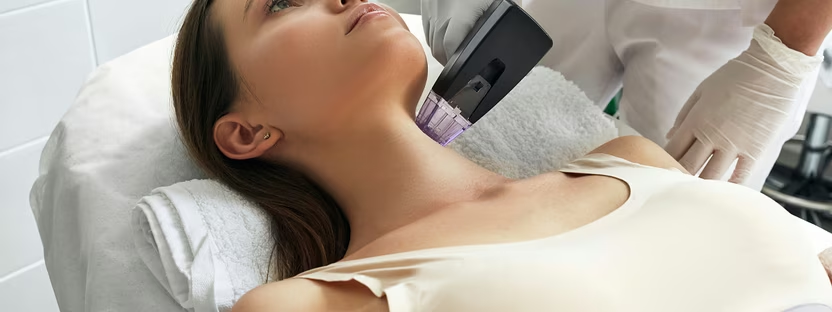
Facial radiofrequency price in Colombia 2026: what nobody tells you
Facial radiofrequency in Bogotá ranges from $40 to $180 USD per session. The difference is not arbitrary — it depends on the equipment, technology, and the professional's profile. Here is what determines the price and how to avoid making the wrong choice.
Read moreReal risks of home radiofrequency
The main limitation of home devices is not risk of harm — with such low power, the risk of serious adverse effects is low. The most real risks are:
Burns from incorrect use: If the device lacks a surface cooling system and is used at maximum power for too long in the same area, a superficial burn may occur. Especially on darker skin types (Fitzpatrick IV–VI) where there is greater energy absorption.
Use on undiagnosed lesions: Heat over pigmented lesions, active infections, or undiagnosed skin lesions can be harmful.
Incorrect expectations that delay appropriate treatment: Perhaps the greatest real risk. Patients who spend a year using a home device without results, when they could have started a professional protocol.
When does buying a home device make sense?
Based on my clinical criteria, a home device may make sense in these situations:
As a complement to a clinical protocol: Using a home device on days between professional sessions may have an additive effect on superficial skin maintenance.
For patients with stable post-protocol results: Once the desired firmness level has been achieved with professional treatment, the home device can help maintain the skin surface.
If budget does not permit professional treatment: In that case, with correct expectations (superficial effect, not real lifting), it may be better than nothing.
It does not make sense as a substitute for professional treatment when real laxity exists requiring deep collagen stimulation.
The complete comparison
| Feature | Home RF | Professional RF (clinic) |
|---|---|---|
| Power | 2–5 W | 50–200 W |
| Penetration depth | 1–2 mm | 4–6 mm |
| Tissue temperature | Rarely reaches 42°C | Controlled at 42–44°C |
| Neocollagenesis | Minimal | Significant |
| Effect on laxity | Superficial | Moderate-to-significant |
| Sessions to see change | Dozens-months | 4–6 sessions |
| Medical supervision | No | Yes |
| Cost per result | Similar or greater long-term | Higher per session, lower long-term |
If you are evaluating whether professional treatment is the right option for you, we invite you to learn about facial radiofrequency treatments at our clinic and request an evaluation consultation.
Dr. Tatiana Leal is an aesthetic medicine specialist in Bogotá, Colombia.
Am I a candidate for facial radiofrequency? Dr. Tatiana Leal's honest guide
Not every patient is an ideal candidate for facial radiofrequency, and that is fine. Dr. Tatiana Leal explains the optimal profile, when RF is not enough, and what alternatives exist for each case.
Read more
Frequently asked questions
Do home facial radiofrequency devices actually work?
Home radiofrequency devices have very limited power (2–5 W) compared to medical equipment (50–200 W). This means the therapeutic temperature required to stimulate collagen production (42–44°C in the dermis) is rarely reached with home use. They may have a superficial maintenance effect if used correctly, but they do not substitute professional treatments for real results.
Is it safe to use a radiofrequency device at home?
If the device has CE or FDA certification for home use and instructions are followed, the risk of serious adverse effects is low because power is very limited. Risk is higher with uncertified devices or if intensity is artificially increased. The main limitation is not safety but efficacy.
How much more powerful is a medical radiofrequency device compared to a home one?
A home radiofrequency device emits 2 to 5 watts of power. A professional medical device emits 50 to 200 watts. This power difference (10–100 times greater) is what allows medical devices to reach therapeutic temperature in the deep skin layers where collagen is stimulated. With a home device, the generated heat rarely penetrates more than 1–2 mm.