
I’m going to be completely direct with you.
One of these options is surgery under general anesthesia with serious surgical risks. The other is an injectable biostimulator without incisions, with its own risks that you also need to know.
If you’re torn between Sculptra glúteos and BBL (Brazilian Butt Lift), this is the single most important distinction you need to know: the type of procedure and the type of risk you take on with each. Dr. Tatiana Leal’s clinic does not perform gluteal surgery (neither BBL nor implants).
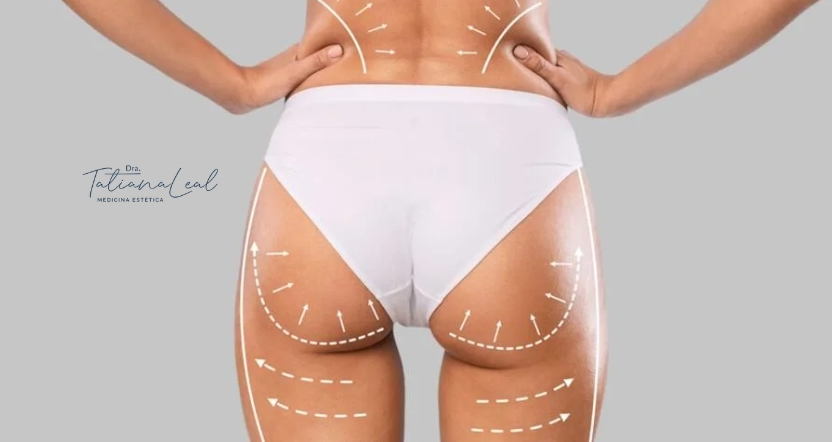
What exactly is a BBL?
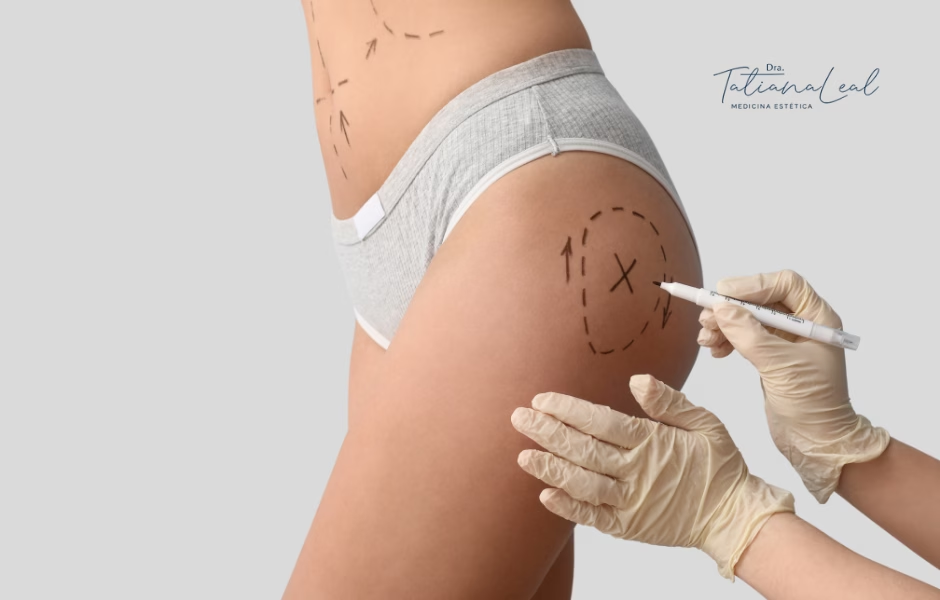
A Brazilian Butt Lift is buttock augmentation surgery that involves:
- Liposuction of fat from other areas of the body (abdomen, flanks, back)
- Processing and purifying that fat
- Injecting the purified fat into the buttocks through surgical incisions
Fat embolism risk in BBL: what to know before surgery
BBL is performed under general anesthesia and carries serious surgical risks, including fat embolism. If you decide on surgery, ask your surgeon about their technique and how they manage this risk.
How fat embolism happens
The main cause is accidental injection of fat into large blood vessels:
- Fat enters the deep gluteal vein
- It travels toward the heart or lungs
- It causes a fatal fat embolism
- It can be fatal, during or immediately after surgery
This is an inherent risk of BBL because the gluteal veins sit close to where the fat is injected, and they can be punctured accidentally even by highly experienced surgeons.
Other serious risks of BBL
Beyond fat embolism, BBL carries significant complications:
- Fat necrosis: Death of the transferred fat tissue, requiring corrective surgery
- Serious infections: Due to the large amount of tissue manipulated
- Significant asymmetry: If the fat is absorbed unevenly
- Intestinal perforation: If the cannula accidentally punctures the abdominal wall (a serious surgical risk)
- Severe hemorrhage: Possible significant blood loss during surgery
- Prolonged recovery: several weeks to return to normal
What is Sculptra glúteos?
Sculptra is a collagen biostimulator (poly-L-lactic acid) applied through injections into the buttocks.
How it works
Sculptra is NOT a filler and it doesn’t add bulk volume directly. It works in a completely different way:
- Deep injection: Sculptra is injected into the deep plane of the buttocks, not into the superficial fat tissue
- Biostimulation: Sculptra acts as a “scaffold” that stimulates your own cells to produce new collagen
- Gradual growth: Volume increase isn’t immediate — it happens progressively over 3-6 months
- Natural results: The new collagen is yours, integrated into your own tissue
Sculptra’s safety profile
Sculptra has a different risk profile from surgery, but it is not risk-free. Possible reactions are:
- Bruising and swelling in the treated area
- Subcutaneous nodules, which can appear weeks or months later; this is why treatment is split into sessions and a massage protocol is prescribed
- Infection, as with any injection, if asepsis measures are not followed
- Uneven result or asymmetry, corrected with later sessions
What sets it apart from BBL:
- It’s a biocompatible, reabsorbable product
- It doesn’t require incisions, general anesthesia, or hospitalization
- No fat is transferred, so there is no fat embolism risk by that mechanism
- The dose is controlled at each session to reduce complications
Regulatory status: the gluteal area is among the areas listed in Sculptra’s INVIMA registration 2017DM-0017014 (valid until October 20, 2027). In the US, the FDA approves Sculptra for facial use only; gluteal use there is off-label.
Dr. Tatiana Leal is the specialist for Sculptra glúteos in Bogotá with the complete 5-5-5 protocol.
Detailed comparison: Sculptra vs BBL
| Aspect | Sculptra Glúteos | BBL (Brazilian Butt Lift) |
|---|---|---|
| Procedure type | Biostimulation (non-surgical) | Major surgery |
| Anesthesia | Local | General |
| Hospitalization | Not required | Depends on the center and the case |
| Incisions | None | Yes, incisions on hips and buttocks |
| Recovery | A few days | Several weeks |
| Post-procedure pain | Mild to moderate | Moderate to severe |
| Main risks | Bruising, swelling, nodules | Surgical and general anesthesia risks, fat embolism |
| Fat embolism risk | Not applicable (no fat transferred) | Yes |
| Infections | Possible, as with any injection | Possible, with greater potential severity |
| Scarring | None | Visible at incision sites |
| Total cost | $10,400,000 to $15,600,000 COP (4 to 6 vials) | Varies by surgeon and center |
| Duration of results | 2-3 years | Permanent (though transferred fat can reabsorb) |
| Type of volume | Progressive natural collagen | Immediate transferred fat |

Sculptra vs Radiesse for buttocks: which to choose in 2026?
Sculptra or Radiesse for buttocks? Discover the key differences, real results and which collagen stimulator to choose for your specific case.
Read moreWhat results should you expect from each?
Sculptra glúteos results
Volume: Moderate to significant increase depending on the number of vials (generally 4-6 vials for complete results) Nature: gradual — the volume is your own collagen Progression: Results appear gradually over 2-6 months Duration: 2-3 years (the collagen remains, then slowly diminishes) Additional improvement: Enhanced skin texture, reduced cellulite, firmer skin
BBL results
Volume: Dramatic, immediate increase (however much fat can be transferred) Nature: Can look natural if the surgeon is skilled; can look artificial if there’s excess volume Progression: Results visible immediately after surgery Duration: Permanent (though part of the transferred fat can reabsorb, mostly in the first year) Additional improvement: Simultaneous contouring of donor areas (abdomen, flanks)
Ideal patient profile for each treatment
Sculptra glúteos: Are you the ideal candidate?
You’re an ideal candidate if:
- You’re looking for a moderate to significant increase, not a dramatic one
- You prioritize safety over extreme results
- You want to avoid surgery, general anesthesia, and hospitalization
- You have a healthy base of skin and tissue (Sculptra needs collagen to work with)
- You prefer progressive, natural-looking results
- You have 2-3 months to wait for the full result (the biostimulator needs time)
- Your budget fits the protocol of $10,400,000 to $15,600,000 COP (4 to 6 vials)
You’re NOT a great fit if:
- You’re looking for immediate, dramatic “Instagram” results
- Your budget comfortably allows a higher-cost surgery
- You have excess body fat that a surgeon could transfer
- You expect permanent, definitive results
BBL: Are you the ideal candidate?
You’re an ideal candidate if:
- You’re looking for a dramatic, immediate volume increase
- You have enough body fat in donor areas (not very thin)
- Your budget covers surgery under general anesthesia with hospital or surgical-center care
- You understand and accept the serious surgical risks, including fat embolism
- You can dedicate several weeks to full recovery
- You want simultaneous contouring of your abdomen, flanks, and back
You’re NOT a great fit if:
- You’re very thin and don’t have fat to transfer (you’d need implants instead)
- Your budget doesn’t cover this kind of surgery
- You prefer to avoid the risks of major surgery
- You have a severe fear of surgery and general anesthesia
- You have medical conditions that contraindicate major surgery
Cost comparison: Which is more affordable?
Sculptra glúteos
Price per vial: $2,600,000 COP
Complete protocol (4-6 vials): $10,400,000 to $15,600,000 COP
Includes:
- Assessment consultation
- The 5-5-5 protocol (mandatory massages)
- All sessions of the protocol (generally 3 sessions)
- Post-treatment follow-up
Additional costs: None (no hospitalization, anesthesia, medications, or missed workdays)
BBL
Price: the clinic does not perform BBL and has no rate to quote; each surgeon and center quotes according to the case.
Varies according to:
- Amount of fat transferred
- Complexity of the case
- Surgeon’s experience and reputation
- City and clinic chosen
Includes:
- Surgeon’s fees
- Operating room costs
- General anesthesia
- Hospital or surgical-center stay, depending on the case
- Post-operative medications
Additional costs:
- Missed workdays (several weeks)
- Specialized post-operative garments (compression girdle)
- Possible corrective procedures if complications arise
- Travel if the surgeon isn’t in your city
The real total-value math
If you consider:
| Factor | Sculptra | BBL |
|---|---|---|
| Procedure cost | $10,400,000 to $15,600,000 COP | Per the surgeon’s quote |
| Hospitalization | Not required | Can add to the cost, depending on the center |
| Missed workdays | A few days | Several weeks |
| Specialized garments | Not required | Compression girdle |
| Corrective procedures | Additional sessions if needed | Possible, at their own cost |
When comparing, add hospitalization, missed workdays, the girdle, and possible corrective procedures to the operating-room price.
Butt lift cost 2026: how much you save with a non-surgical BBL in Colombia
Read moreDecisions only you can make
I’m not going to tell you what to choose. That’s a personal decision that depends on your priorities, values, and circumstances.
What I WILL do is make sure you have all the information you need to make an informed decision.
If you want to avoid the risks of major surgery
Sculptra avoids general anesthesia, incisions, and the risk of fat embolism, but it keeps its own risks (bruising, swelling, nodules). If staying out of the operating room is your priority, Sculptra is the option that fits.
If you prioritize dramatic, immediate results
The choice is clear: BBL.
Sculptra will never achieve the degree of augmentation a well-executed BBL can. If you’re looking for that dramatic, social-media-style transformation, Sculptra will probably disappoint you.
If you’re looking for a balance between safety and results
This is where the decision becomes complex and deeply personal.
- Sculptra offers you: a non-surgical procedure, fast recovery, natural but gradual results, moderate augmentation
- BBL offers you: serious surgical risks, prolonged recovery, immediate but dramatic results, significant augmentation
Only you can decide which balance is right for you.
My experience with both options
As a physician who sees patients torn between both options, here is what I observe in consultation:
Patients with Sculptra
The happiest Sculptra patients are the ones who:
- Understand that results are progressive (2-6 months for the full effect)
- Value naturalness over dramatic change
- Appreciate not having to recover from surgery
- Know the risks of Sculptra (bruising, swelling, nodules) and follow the massage protocol
Patients with BBL
The happiest BBL patients are the ones who:
- Are good candidates with enough body fat
- Choose surgeons with excellent reputations and experience
- Understand the risks and accept that they exist
- Have the time and financial means to dedicate to full recovery
What I’ve observed
Patients who regret their choice, whichever it was, are usually the ones who didn’t fully understand the expectations or the risks.
Success isn’t about picking the abstract “best option.” Success is about choosing the right option for YOU.
Frequently asked questions about Sculptra vs BBL
Can I get Sculptra if I already had a BBL?
Yes, with a few considerations:
- You should wait at least 6 months after the BBL to allow the tissue to fully heal
- A medical assessment determines whether your case is suitable
- If the fat from the BBL partially reabsorbed, Sculptra can help correct the asymmetry
Can I get a BBL after Sculptra?
Yes, but:
- You should wait at least 6-12 months after Sculptra for the collagen to stabilize
- The surgeon may prefer not to perform a BBL if there’s a lot of new collagen in the buttocks, since it can complicate surgery
- Many patients find that Sculptra alone is enough and they don’t need a BBL
If Sculptra isn’t enough, can I get a BBL afterward?
Absolutely. These are completely different procedures and they don’t contradict each other. In fact, many patients try Sculptra first to see if they’re happy with the natural result, and if they decide they want more, they consider BBL afterward.
Which one is more painful?
- Sculptra: Mild to moderate pain during the injection; mild discomfort during 3-5 days of recovery
- BBL: Moderate to severe pain during the first weeks after surgery; residual muscle soreness may remain
BBL is significantly more painful both during the procedure and throughout recovery.
Why does Sculptra require 3 sessions?
Sculptra is applied in a protocol of 3 sessions (generally spaced 4-6 weeks apart) for two reasons:
- Safety: Applying all the product at once increases the risk of nodules
- Effectiveness: A gradual protocol lets the result be adjusted at each session
It’s not a trick to charge more. It’s the medically correct way to apply Sculptra.
Your decision: Informed and conscious
The choice between Sculptra glúteos and BBL is one of the most important aesthetic decisions you can make. It affects your safety, your appearance, your finances, and your day-to-day life for weeks or months.
Before deciding, ask yourself these honest questions:
- How much importance do I place on avoiding major surgery? Is it my number one priority?
- Am I willing to accept the serious surgical risks of BBL, including fat embolism, to achieve dramatic results?
- Do I prefer progressive, natural results, or immediate, dramatic ones?
- Do I have the time and capacity to dedicate to several weeks of recovery?
- Does my budget fit a BBL quoted by a surgeon, or the Sculptra protocol ($10,400,000 to $15,600,000 COP)?
- Do I truly understand that Sculptra is biostimulation (not a filler or surgery) and requires months to see the full result?
Dr. Tatiana Leal offers an honest consultation where we’ll evaluate your case, explain both options in detail, and help you make the informed decision that’s right for you. Book your appointment today.
Whatever you choose, what matters is that it’s based on complete information, realistic expectations, and a deep understanding of what each procedure actually offers… and what it doesn’t.
Want to learn more about this treatment?
Schedule your consultation with our doctors and discover the ideal treatment for you
Reserve your spot In-person consultation in Bogotá, Colombia (Av. Suba #114-59). Live in another city or abroad? Travel to your appointment or book a virtual assessment, same price.Last updated: March 2026
Results may vary from person to person. All procedures are performed by certified physicians at our facilities.
Colombian butt lift vs Brazilian BBL: which non-surgical option is right for you
Read more
Frequently asked questions
What realistic volume increase can patients expect from Sculptra versus a BBL for gluteal enhancement?
A Brazilian Butt Lift can increase gluteal projection by several centimeters through large-volume fat transfer, making it suitable for patients seeking substantial reshaping. Sculptra typically delivers modest, progressive improvement in firmness and contour — ideal for patients wanting subtle enhancement or who are not candidates for surgery.
Who is NOT a good candidate for Sculptra gluteos compared to a BBL?
Sculptra is not recommended for patients with very low body fat, since it requires adequate soft tissue for proper product integration. Conversely, patients seeking dramatic augmentation, significant projection increase, or specific shape remodeling are better served by BBL, assuming they meet surgical health requirements.
How do the long-term maintenance costs of Sculptra compare to a BBL over five years?
Sculptra requires repeat sessions every 18 to 24 months to sustain results, and the cost depends on the number of vials needed (each vial: $2,600,000). A BBL is a single intervention that offers more permanent structural results assuming stable body weight, but it may need surgical touch-ups if the transferred fat reabsorbs.
Can you receive Sculptra treatments after having a Brazilian Butt Lift?
Yes, Sculptra can be used after a BBL to address areas where fat resorption occurred or to refine contour asymmetries. Most physicians recommend waiting at least six months post-BBL for full fat graft stabilization before introducing any injectable biostimulator in the same region.
What are the key safety profile differences between Sculptra and BBL for buttock augmentation?
BBL is surgery under general anesthesia with serious surgical risks, including fat embolism, which demands meticulous surgical technique and careful patient selection. Sculptra involves no incisions or general anesthesia, but it also has risks: nodule formation, bruising, swelling, and uneven correction, which are usually managed without hospitalization. Neither option is risk-free.