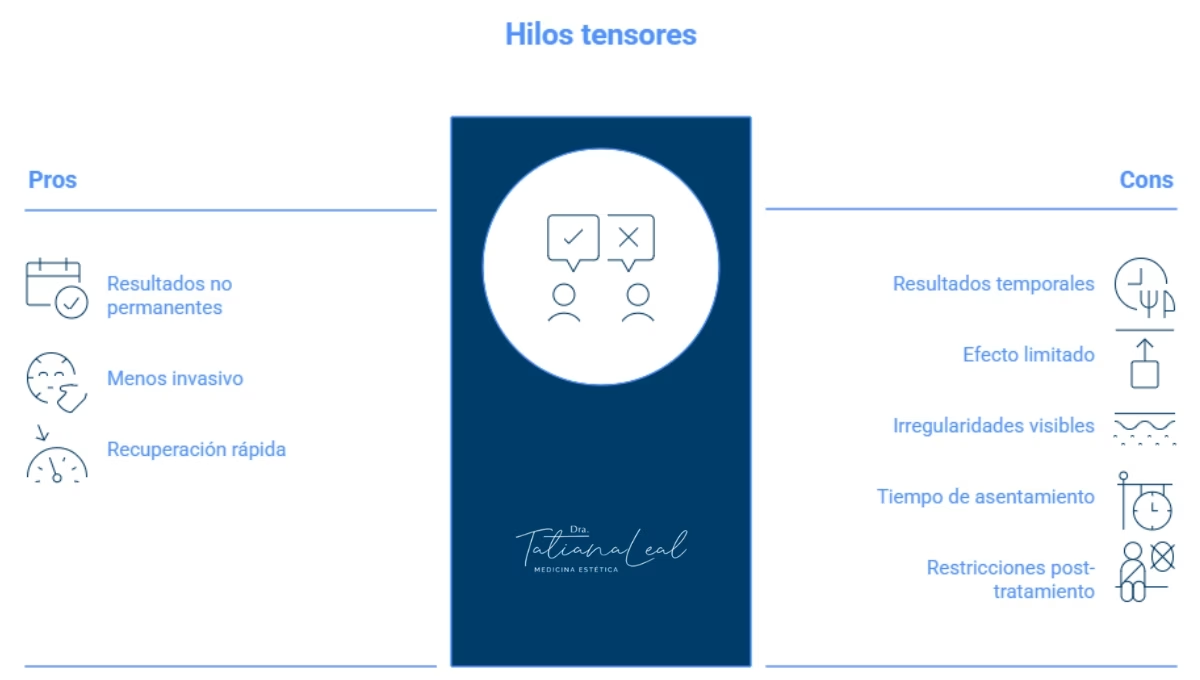
Thread lift disadvantages: Total transparency
If you’re researching thread lifts, you’ve probably seen a lot of promotional information highlighting only the benefits. As a doctor with 18 years of experience, I believe you deserve to know the real disadvantages to make an informed decision.
PDO thread lifts are an excellent treatment, but they’re not perfect and they’re not for everyone. Here I’ll tell you what no one else will.
Main disadvantages of thread lifts
1. Temporary results
The most obvious disadvantage: results are not permanent.
| Thread type | Effect duration |
|---|---|
| PDO smooth | 8-10 months |
| PDO barbed | 10-12 months |
| PCL (Polycaprolactone) | 18-24 months |
| PLLA (Poly-L-lactic acid) | 24+ months |
Practical implication: You must repeat the treatment annually to maintain results, which implies a recurring cost.
Unlike a surgical facelift that can last 10 years, thread lifts require periodic maintenance. However, this can also be an advantage: if you don’t like the results, they’re not permanent.
2. Limited effect on severe sagging
Thread lifts cannot lift significant excess skin. If you have:
- Advanced sagging (over 60 with lots of excess skin)
- Massive weight loss that left hanging skin
- Expectation of surgical-like results
Then thread lifts are not for you. The only effective solution in these cases is rhytidectomy (surgical facelift).
3. Possibility of visible irregularities
Although rare in expert hands, they can appear:
- Lumps or nodules: Especially in very thin skins
- Depressions: From irregular tissue tension
- Visible bands: If threads are placed too superficially
Key factor: This risk is directly related to the professional’s experience. In my practice, the rate of irregularities requiring intervention is less than 2%.
4. “Settling” time
During the first 2-4 weeks, the result is not definitive:
- Inflammation can distort the initial result
- You may feel the threads to the touch temporarily
- The tissue needs time to adapt to the new position
Inconvenience: It’s not a treatment to do days before an important event.
5. Post-treatment restrictions
After the procedure, you must avoid:
- Intense exercise for 1-2 weeks
- Facial treatments for 3-4 weeks
- Direct sun exposure for 2-3 weeks
- Sleeping face down for the first week
- Dental visits with prolonged mouth opening
Bad results with thread lifts: Causes and solutions
Why do you see bad results on the internet?
Images of thread lift “disasters” usually have identifiable causes:
Cause 1: Unqualified professional
The most common problem. Thread lifts seem simple, but they require:
- Deep knowledge of facial anatomy
- Precise insertion technique
- Ability to foresee the final result
- Skill to manage complications
Solution: Always verify it’s a certified doctor with specific training in thread lifts.
Cause 2: Low-quality materials
Non-certified threads can:
- Break during insertion
- Not provide adequate tension
- Generate severe inflammatory reactions
- Leave permanent irregularities
Solution: Ask about the thread brand and its INVIMA registration. In my office, I only use certified materials from recognized brands.
Cause 3: Incorrect indication
Applying thread lifts to patients who aren’t adequate candidates:
- People with severe sagging
- Extremely thin skins
- Unrealistic expectations of results
Solution: A good doctor will tell you “NO” if you’re not an adequate candidate.
Cause 4: Excess tension
Wanting to achieve too much with threads can cause:
- Unnatural stretched appearance
- Asymmetries from uneven traction
- Visible irregularities
Solution: Less is more. A natural result is preferable to an exaggerated one.
Poorly placed thread lifts: How to identify them?
If you’ve already had thread lifts and suspect something isn’t right, these are the warning signs:
Signs of immediate problem (first 48 hours)
- ❌ Intense pain not relieved by analgesics
- ❌ Excessive and asymmetric inflammation
- ❌ Intense redness and heat in the area
- ❌ Fever
Action: Contact your doctor immediately. These signs may indicate infection.
Signs of medium-term problem (2-4 weeks)
- ❌ Visible lumps that don’t decrease
- ❌ Marked asymmetry that persists
- ❌ Threads visible through the skin
- ❌ Depressions or sinking
Action: Schedule a review consultation. Most can be corrected.
Signs of long-term problem (more than 1 month)
- ❌ Unnatural or “stretched” result
- ❌ Permanent irregularities
- ❌ Dissatisfaction with the result
Action: Seek a second professional opinion. Correction options include massages, touch-ups, or thread removal.
Can bad results be corrected?
The good news is that most bad results have a solution:
Correction options
| Problem | Possible solution |
|---|---|
| Small lumps | Massage + time (2-4 weeks) |
| Persistent lumps | Saline infiltration |
| Mild asymmetry | Touch-up with additional threads |
| Marked asymmetry | Removal and repositioning |
| Very visible threads | Simple removal |
| Insufficient result | Add more threads or combine with other treatments |
| Excessive result | Relaxation massages + time |
Important: PDO threads are absorbable. Even in the worst scenario, the result is not permanent. This is a “safety net” that other procedures don’t have.
Comparison: Disadvantages vs Advantages
To make an informed decision, compare both sides:
Disadvantages
- Temporary results (8-12 months)
- Doesn’t correct severe sagging
- Possible irregularities
- Requires maintenance
- Post-treatment restrictions
- Result largely depends on the professional
Advantages
- No surgery or scars
- Quick recovery (3 days)
- 20-minute procedure
- Local anesthesia only
- Natural results
- Reversible if necessary
- Stimulates collagen production
- Lower cost than surgery
Is it worth it despite the disadvantages?
For most patients, yes, it’s worth it when:
- ✅ You have mild to moderate sagging
- ✅ You want natural results
- ✅ You don’t want surgery
- ✅ You have realistic expectations
- ✅ You choose a qualified professional
- ✅ You understand it requires maintenance
It’s not worth it if:
- ❌ You’re looking for permanent results
- ❌ You have severe sagging
- ❌ You expect surgical facelift results
- ❌ You can’t afford annual maintenance
- ❌ You can’t follow post-treatment care
Frequently asked questions about disadvantages
What if I don’t like the results?
Threads can be removed during the first weeks. After that time, the result remains until the threads absorb (8-12 months).
Do thread lifts worsen sagging over time?
No. This is a myth. Threads stimulate collagen production, which can improve skin quality long-term.
Is it normal to feel the threads to the touch?
During the first 2-3 weeks, it’s normal to feel some irregularity. Afterward, the threads integrate with the tissue and aren’t perceptible.
What percentage of patients have bad results?
In expert hands, the rate of significant complications is less than 5%. The satisfaction rate exceeds 90% when the procedure is well-indicated.
Can I get thread lifts if I already have fillers?
Yes, they’re compatible. In fact, they’re often combined for more complete results. Your doctor will determine the right timing for each treatment.
How long should I wait to see the final result?
The lifting effect is immediate, but the final result is seen at 4-6 weeks, when inflammation has completely subsided and collagen has started to form.

Conclusion
Thread lifts have real disadvantages you should consider. However, when the procedure is well-indicated, performed by a qualified professional, and with realistic expectations, satisfaction is very high.
The key is in the choice of professional and having an honest consultation where it’s evaluated whether you’re an adequate candidate.
If you want to know if thread lifts are for you, I invite you to a consultation where I’ll evaluate your specific case with total honesty.
Want to learn more about this treatment?
Schedule a free consultation with our doctors and discover the ideal treatment for you
Start your transformation Limited spots * Limited spots this weekUpdated: February 2026
This article is for informational purposes and does not replace consultation with a medical professional. Each case is unique and requires personalized evaluation.